The Benefits and Nerves of Writing Groups


This is a guest post from my friend, Cori Nelson. She’s a writer of children’s books and middle-grade novels. Right now, Cori is writing her thesis. She traveled halfway around the globe to continue her writing career. Check out her WordPress blog and scroll through her tweets if you’re so inclined.


Writing is a lonely business. That seems like a pretty generic statement, but it’s true! As a writer, you sit alone with your computer or notebook and argue with yourself over and over and over about plot and grammar and spelling. Being trapped in your own head all the time is not only lonely, but it can hinder your ability to make good decisions (not to mention drive you completely crazy). This is why I think every writer should join a writing group.


This year, I’ve been studying Writing for Children at the University of Winchester. Through the course, I’ve had to share my work in progress with others and then receive instant critiques on my writing. As an introverted, I’m-fine-sitting-in-the-corner-by-myself kind of person, I was very nervous about this concept. I remember reading my first piece out, my voice and hands shaky, my brain forcing me to read at top speed to get it over with. But afterwards! After my voice faded away from the room, after the short awkward silence that follows any reading, after everyone stopped writing down their thoughts on the excerpt in front of them and looked at me, was amazing. My classmates, people I had just met for the first time a week ago, went around the room and told me all of their thoughts, good and bad.


wordblock


It was incredible. And it felt so good to share my writing with others and have them not only like and understand it, but give me feedback that was helpful, too.


Receiving the feedback immediately after reading my writing out was great, too, and something that I think makes in-person writing groups better than remote. It’s nerve-racking enough to read your work in progress out in person and getting feedback right away. I can’t imagine the agony you would feel sending your work in progress to someone and having to wait weeks for their thoughts. Plus, as a children’s writer, I like to write funny. There is simply nothing better than reading something you wrote out loud and listening to your group members laugh at the moments you were hoping were actually funny. That’s something you cannot get with a remote writing group.

felix-mooneeram-222805

It can definitely be very scary to share your writing with others, as writing is a very personal thing, but there are so many things you just do not catch when reading through your own work. Your eyes glaze over a missing ‘the’ just assuming it’s there, your brain tells you that a sentence makes complete sense, when really it’s just a jumble of nonsense. Someone unfamiliar with your work, though, will catch all of those things. She’ll notice when you’ve used the same word twice within two sentences and when one character sounds the exact same as another and will ask the all-important “but why?” to a scene that actually, now that you’re thinking about it, doesn’t make a whole lot of sense. Having someone else read your work is so helpful, I can’t say it enough!


All of my classes here in Winchester were designed to have a lecture for the first half and a workshop for the second half. Eventually, I began to yearn for the workshop half of class, especially when it was my turn to read and there was something I was stuck on with my piece and needed to discuss.

chuttersnap-317197

Along with helping you find grammar and spelling errors, and helping you to better understand your own story by asking questions and giving suggestions, a writing group is a great support system. The group I’m in now (that I sadly have to leave in less than a month!) is amazing, to say the very least. It is made up of some of the most talented children’s writers I have ever met. Each and every one of us is devoted to each other’s writing as if it’s our own. When one member of the group has a victory (like hitting a word count goal), the entire group celebrates. When a member has a setback or is doubting themselves and their work, the entire group comes together to reassure them that they’re not a terrible writer, to offer suggestions to help stimulate new ideas, to offer the sympathetic and always appreciated “it’s going to be okay”. And when a member is having irrational thoughts about their work in progress, the entire group is there to help talk them off the ledge, to remind them that an idea had mid-dream is not always the best idea, and that “no, rewriting your entire dissertation two weeks before hand-in probably isn’t the best idea.” talking from experience, here. I honestly had a thought about rewriting my entire book even though it’s due at the end of the month. Thankfully, my writing group members stepped in with some rational thinking to save the day.


It’s important for everyone to have people like this in your life, true. But as a writer, I think it’s even more important because they’ll help you to keep going. As I said earlier, writing is a very lonely business. It is so easy to get lost in your own thoughts, especially the bad thoughts that tell you you’re not good, that your writing is awful, that you should just give up.


JK Rowling got hundreds of rejection letters when she started querying Harry Potter. As did Stephen King before he made it. As did Kate DiCamillo. As did every single author who’s ever been published. And I can guarantee you that all of them had a support system of some kind to help them get through the many rejections. If not an entire writing group, then at least someone who believed in them and their writing. At the end of the day, what more can you ask for?

GKsubscribe button

The Forest for the Trees: The Way to Be a Fiction Writer


Betsy Learner is a writer, editor, and agent. In The Forest for the Trees, she offers a collection of sage advice for any writer, especially when you’re questioning your ability as a writer. Reading this book helped a lot. I’m on the right path and need to wo4k more before I get there.


The first half of the book identifies several different types of writers. There’s something in there for everyone. I identified with several things that matched. When I’m the most truthful and unafraid, my writing is at its best. Very few writers are naturally successful. The vast majority need to work really hard to get in and become something. The process of writing and getting good is a long process. Write, get feedback, make improvements, write, and repeat until you arrive. Throughout there are many examples from a ton of successful writers and how they got started.


The second half of the book is about the publishing side of things. Betsy tells us how she started and moved through the publishing world. These are my biggest takeaways. Sometimes you find a person that can voice your inklings about something you wrote. A good editor should also alight on those things. Query letters are replied in several ways. The first stage is a form rejection letter. Then a form letter with a little personalization. Third a personalized response and finally an acceptance letter. Seeing the process of traditional publication was like witnessing someone else living your dream. One day, that’ll be me. I’ll get there.


Later guys.


GK

subscribe button

A Few Mini Dreams: Paper Nightmare, Escape of the Innocent, and Flying Through Life


A few mini dreams:


Thrown papers fly at me through a slammed open door. Each one impacts with a great puff of smoke, forcing me back with each incoming blow. Eventually, I trip into a pool of paper at the end of a test wallpapered hall, flailing in the ruddy pool, and slowly sinking into black ink swirling beneath the surface. All I can see is failing grades while I drown.


I run upstairs chased by an unknown foe, into my bedroom, and try to escape. A huge dream creation of a dog confronts me with a bark, actually waiting for me to climb onto his back. We emerge through the door, land on the enemy, descend the stairs, and spot an evil accomplice. Racing back into the bedroom avoids the unsurprised wrongdoer. The dog and I jump off a diving board outside the open window, through a horizontal mullioned greenhouse roof, land on thick palm fronds growing from the ground unscathed, and make our escape.


Controlling a miniature airplane with my tech flies it around perfectly. I sit inside the tiny cockpit, soaring through the clouds, along a highway, under an overpass, and keep flying. I somehow maneuver through a bedroom window and land on the floor.


GK

subscribe button

Book 2: The Characters that Make the Tapestry


The Trouble with Dreams requires really strong characters to pull off the story I have in mind. Six characters that allow us into their lives to see it for what it is. Then we need to peer deeper to understand their inner dreams. Also what factors are preventing them from what they truly, deeply want in life? That’s a lot of weight placed on small human shoulders. Let’s make them mighty.


What prevents people from getting addicted to prescription drugs? A support network. I wanted this place addiction to be stronger than reality. Showing people at various levels of success would do that. I wanted average people for their lot in life. And what’s the best way to reframe addiction in a way that’s new, visceral, and real? Make the addiction instead an experience that’s their dream life incarnate. And there we have the concept.


I needed compelling characters that go through this experience. I started with a homeless veteran with PTSD and cancer. Uplifting, right? Jk. A large percentage of the homeless are veterans. I wanted to make it a choice superficially, but we all know there’s more to it than that. Chris manages his PTSD by limiting stimulus that triggers his symptoms, like sound and movement. He has a family ready to help, but everyday things trigger him. The potential for him to hurt a loved one is always there.


Then we have an ex-con. It started as a male character but later turned into a woman. Getting a job as an ex-con is really difficult. Most ex-felons are black and reoffend. Unable to get a legal job, she returns to the only thing she knows, car theft. I know very little about low-tech car theft. Mix in those wireless key fobs and then it gets interesting. Software defined radio, RFID, Bluetooth hacking, wifi hacking, deep packet inspection, copying packets and retransmitting. Computer stuff. Never actually done it. I know the general principles and the thought process. She’s trying to be reunited with her daughter.


Then we have Elise (Lotus Elise comes to mind). Elise is a high-end call girl. The company keeps employees under tight control by getting them hooked on prescription painkillers. I wanted Elise to have surrogate relationships with her clients. I also wanted the story of how she got there.


Then we have an author. Michael wants to publish a romance novel, but his first book is a tremendously well-selling pick-up artist guide. He’s hung up on a patient he had as a therapist and is nearly in love with his escort. I connected each character to every other to resemble the fact that everything’s connected. Michael stays sane by picking up women for fun. That should work out really well for him, right? Sarcastic.


Then we have a closeted lesbian lawyer. She has a partner that the firm doesn’t know about. Add a nice apartment and a few cats. Her struggle is getting pregnant through IVF. Some medical issues causing it to be very difficult.


Then a millionaire founder like Elon Musk. Supermodel wife and the works.


Finally, we have a psychologist that interacts with all the rest. Larissa Emery is the common thread through the story. I wasn’t clear on her storyline at the beginning. It grew into her suspicion that her husband was cheating on her. She finds the truth and deals with it. Her interaction with her patients (the other characters), help her decide what to do.


I wrote each point of view separately as if writing an independent story without worrying about fitting everything together. I started with Chris. To get the story under 50,000 words, each of the seven parts should be 7,000 words. Chris’s part took 10,000. My word counts would be higher for the other characters. My vision for the story was too big for my goals. I cut back the characters to four. Chris, Elise, Michael, and Larissa. That grew into The Trouble with Dreams. The entire first draft took ten months and now out to beta readers.


GK

subscribe button

Book 2: The Trouble with Dreams

I tried getting Remember, my first book an Agent. That work was the best I could manage then. It was sheer audacity to believe Remember was the correct fit to be published. Since then, I’ve learned so much about writing. I needed something more relevant and approachable. More than that, it needed to be marketable. Would the work be appealing beyond the angle of dropping the reader into the character’s shoes?

That gave me a hit list. A list of things that the next book required. Some givens were already established so far in my writing career. A psychological thriller, futuristic optional, character driven, and involving love somewhere along the line. I also wanted something that’s set in reality, relatable, 50,000 words, and with average characters. Not all analytical scientists. I also wanted a few hangers-on from the Remember Sequel. That ended up as multiple points of view. I also wanted simple, easy to understand prose that allows the story to get across.

I came up with a few ideas/concepts.

1. the Earth is really one big machine that can teleport

2. a ghost sucks life force and vanishes after the people die

3. a cat turns into a human, helped to become a successful human designing cat toys

4. an alien world with varied population, mainly very thin humanoids that neatly float away without gear weighing them down, from high gravity home world chases down criminal just to allow escape

5. snake civilization of high intelligence makes heaters from fire to stay warm and hunt down larger animals  for food

And finally the idea I stuck with:

  1. place addiction

That idea came from a weird place. We all know about addiction to chemicals like cigarettes, alcohol, opioids, methamphetamine, benzodiazepines, marijuana, and various other things. The jargon abounds with these obviously. Let’s extend that to something more like love. Put on your nihilist hat, please. Love is basically an addiction to a person. Being around a particular person you love, triggers a highly complex, not well understood the neurochemical cascade of dopamine, oxytocin, and numerous others. Now, what about a place? Can people become chemically addicted to a place? Yes, if there’s an association or neural connection that links getting high with a specific place. The next obvious question is what happens if the place no longer works or the dosing ends? If a junkie can only get subpar dope, what happens? Well, we have a pretty good idea. What happens when a great relationship ends abruptly? Hate? Confusion? Betrayal? Inconsolable pain? Suicide? Take your pick. Initially, the idea just appeared as if from nowhere. Looking enough gave the root and stem of the idea/flower.

GK

subscribe button

Editing as a Necessary Evil. What Else Could it Be?


Recently, I’ve been editing Remember. I don’t really like the editing process, but it’s a basic requirement of writing anything. It’s the antithesis of the writing. Editing is a nearly brainless activity in comparison. Editing something over and over still missing some errors is frustrating and motivation crushing. Typo blindness is troublesome. The writer knows the words they intended for the page. Not seeing a few typos each page isn’t really a hindrance for the person that wrote it. This WIRED article does a really good job explaining it. A novel is much more susceptible to typo blindness than say a 10-page research paper. A novel requires a lot of investment. Investment leads to seeing what you want to see, instead of what’s actually on the page.

 wired typos

That’s exactly what happened with Remember. A beta-reader pointed out several typos throughout the book. Unfortunately, I’d already put the ebook and paperback on Amazon. Exactly how that worked out is in an upcoming blog post. I quickly took off those listing. It wasn’t until a few months ago, but I reposted the unedited versions. I’m working on the edits as you’re reading this.

amazon listing 1

After the discovery of numerous typos, I worked out an editing plan. I’d already edited through four drafts at that point. I read slowly through each page twice. Once through a page and then again. Finding typos was easy. The work was time-consuming. I hadn’t yet found a method to stay motivated through more than an hour or so. Two or four pages a day. In a month of doing this, I lost all the motivation I could muster.


The blog has already featured the fruits of my procrastination. I feel too much guilt procrastinating on something completely useless. I have to justify it somehow. That’s how procrastination always starts, as a tangent that can somehow be connected back to the goal. I thought learning Photoshop would help me create book covers that I needed. Then After Effects to make a book trailer. Then 3D modeling for the book trailer. Then game development to practice 3D modeling. This happened in phases between more flawed editing.

wasting time

Through all this, my unconscious was entering the second epoch of my writing style. For some reason I can’t remember, I start thinking along the lines of clarity (an old blog post talked about a writer that showed me the way, Ella Dawson.) I recently read, the biggest mistake of a novice writer is trying to overcompensate for a perceived lack. Usually in the form of over-involved writing. That’s the symptom of Remember. Over complicated prose for confusing and difficult to understand writing. I reasoned if no one can understand what I’m writing, what’s the point. If it isn’t clear, there is no point.


I needed to simplify Remember. I decided to linearize it. Remember started out as two parallel story lines. One was six months ahead of the other. I jumped back and forth. The reader was getting lost. I cut out the boring stuff. Conor court trial and hospital stay were gutted (I’ll post them sometime). I moved the hook later in the novel. I needed a new hook, Conor’s life before the memory loss. What was Conor trying to remember? That should be up on here when I’m putting up the new version of Remember on Amazon.


I wanted the story to be more approachable and familiar. I started switching verb tenses to the past. Earlier in the editing process, I’d already switched out all the verbs for active ones. Tense switching would be much easier. I tried Find and Replace in Word. It was too finicky and took about as much time as the manual way. This verb switching actually helped in the long run. It sufficiently motivated me to cut more of Remember. Cutting from a novel has always been very difficult for me. This extra work of verb switching got me there.


remember cuts
Everything I cut from Remember.


Remember is almost finished. I’ve cut 14,000 words plus, and the novel is better because of it. Listening to music is the motivation I need for editing and typing at times.


Later, guys.


GK

subscribe button

Walking Through the Forest of Night to a House so Bright


A story of transformation, finding something unreal, and seeing things in a new way.


Walking through the black forest shakes trepidation through this vessel. I just walk from some unknown location to the warm comfort of my home, each step concluding in pain, as branches thick and dense scratch up every square inch of open flesh. The continual movement through this underbrush offers a constant reminder of what hides just out of sight in the utter darkness all around. The unavoidable trip over an up-turned root or impact with a hearty low hanging branch adds punishment to my circuitous, wandering journey. I need some way to escape this blind torment — a slight reprieve from this suffering — just something, anything to change this sightless wandering.


A deep thumping moves through the forest floor and into my very bones. The need to brace myself to the strength of a behemoth tree possesses my deliberate action. My touch turns into a hug that becomes a death grip with another mighty, ground shaking vibration. A light reflecting back onto the trees — showing their full depth and complexity — grows with the intensity of a dozen suns in the utter darkness of this endless night. A menacing, throaty, animalistic roar from the omnidirectional distant wood sends a shiver down my spine, raising hair as if preceding electromagnetic discharge. An unwitting glance in the general direction blinds and reveals. I will and force my body to unleash the hold upon this mighty protector, this sentinel of a tree. I reluctantly gaze at the source of bright emanations floating ahead of this feeble body. The illumination acts as a giant obfuscation of my true savior, whatever form of creature may yet it be? I approach with a heart halting terror and unbridled curiosity, unhindered by neither. This encroachment continues until the ultimate conclusion of facing this thing.


The light fades to a faint glimmer of the once magnificent beacon, facing me with the stuff of nightmares — a monstrous feline form waiting to tear meat from bone. The shiny salivating mouth, at the ready, takes no action except to show itself. I feel this undeniable need to touch the top of its slick, black hair covered head, so much so that I just do it. Combing my fingers through the thick, luxurious fur that encompasses this unearthly beast coaxes purrs of the cat’s pleasure. The agape mouth recedes to that of a happy kitten with no interest in ingesting my delicate flesh. Another one of pure white enters the clearing, looking for some unknown treasure. The newcomer requests the same tender moment, displaying its gentle face near that of the other. I indulge the arrival with the same strokes to receive the much needed safety and security. With each stroke, the wild and feral nature of these beasts transforms into the kinder, gentler forms of pet cats with diminutive size.


The two cats pull back as if something calls their attention away from this. They move past me deeper into the overly dense growth. I follow as they are now my acolytes in the unfamiliar terrain, giving myself over to their animalistic instinct with no other recourse than belief in their prerogative. I trust them implicitly as sheep lend themselves to the whim of the herder. They move from branch to branch with a graceful ease, occasionally leaping to ground without faltering. The white lioness, the feline is bombarded with distraction meant to disrupt — wandering thoughts of something unknown. She flees at some indiscernible input abandoning him and me. I follow the member of our party devoted to our mutual interest, getting me out of these accursed woods. We approach a house of black smoking chimney and yellow glow through window. He makes himself comfortable here, a sign for me to enter the hidden, secret chambers within. He swiftly climbs an overhanging tree, drops down upon the lowest eaves, and curls up onto a ball. A peaceful slumber is the lofty goal of this lowly, once majestic creature.


Entering the bleak, sterile innards of this home leaves something to be desired besides modernity. The organic, although dark forms outside provide more of a comfort than this… barren cold. I go through the myriad of metallic cabinets and bins, looking at everything and searching for nothing. The white floor offers the only change from this… storage on every side. I pantomime my way around the room, searching the cold walls for the misplaced door, failing at a hidden compartment or any other such thing. The cold leaches into my hands, trying to rip my very essence away. I stop in futility. A noise startles me into looking one way. The cold at my back melts away to nothingness. A look back offers nothing, except black air surrounding this body. The limited surroundings are no more. Trying to escape the whiteness below, running into the dark proves this space inescapable.


Somethings come out of the black void and surround me in tight ring after ring. The objects flicker into life showing him to me, the black feline lounging above in various states — anything from growling to purring, eating to sleeping, back arching to scratching, and hunting for some elusive prey. The images send me through waves of reflected emotion. The scratching comes to gradual focus. The images look too real for my own good, the scratches too close. The hot searing pain cries out from every part of my outsides. The resulting outflow of blood provides a limited relief. I just want and need this perpetual torment to cease! This unavoidable pain must come to an end. I just have to get out! I welcome the sweet slumber of sleep that is death alone.


GK

subscribe button

The Art of Query: Figuring this Out


After finishing and editing a book, the next step is publication. I’ve had a backup plan in case traditional publications doesn’t work out, self-publishing. There’re a lot of reasons to try traditional publishing. The reach of the work and the focus on writing versus marketing, among others.


Most publishers don’t consider work that isn’t agented. You can find a few smaller publishing houses that consider work directly from writers. So I needed an agent. The whole publishing business is completely foreign to me. Jane Friedman’s site helped a ton. Everything in this post is from there in some form. A great resource for anyone trying to get into the novel writing business.

jane-friedman.jpg

Getting an agent requires a finished manuscript. Then you write a query letter to agents. A query is a cover letter brought to its pinnacle. Basically, this query asks if an agent wants to receive your full manuscript. The easiest way through this process is with someone vouching for you. Very similar to job hunting. If someone can speak for you within the company, getting the job becomes much easier. Writing conferences are the best place as I’ve read. Still, need a query but much easier.


I don’t have any contacts in the publishing business. I need something that works as a great query. Getting traditionally published is very difficult.

jane friedman2

This article I found on Jane Friedmann’s website explains how to write one. First, find an agent that’ll like your book based on what they’ve represented before. Then research the agent and personalize the first paragraph as to how you book is a good fit for them. “I’m querying you because you represented X. I think [My book] would interest you.” Something like that.


Then you list the title and word count. The following paragraph is a short paragraph that sounds like the book. It should extol what the book’s about, it’s virtues, and hook the reader. This is basically like a summary with a hook.


The final paragraph is about your writing related biographical information. Finally, end with asking them to request the full manuscript. And “Thank you for the consideration” or something like that.


Include everything else as directed by the Agent’s submission guidelines. Take this very seriously and double check everything. Agent’s name included.


This is the first query I sent out to agents the first time around. As you can see I didn’t exactly follow those guidelines.


I’m writing you because you helped [X] by [Y] get published.

Please follow Connor Abby in Remember, a science fiction novel with more than a hint of science that runs in a space of 120.000+ words.

Connor Abby — a normal, everyday research scientist — ends up in the middle of an age-old conflict between altruistic science and a science-obsessed government, culminating in the murder of Irena Mekova. Connor undoubtedly gets embroiled in the situation partly due to factors beyond his control. Join him on a journey through a world of tech, dreams, and shifting alliances. Discover what he’s really capable of. Is Connor ultimately responsible? Is he guilty of murder? You decide!

Please request the full manuscript.

Thank you for the consideration,


I didn’t get positive replies. I thought the query didn’t really match the writing style of Remember. I tried a different query. This one below. I should’ve cut the biographical information. Nothing related to writing.


I am writing to you because, you helped [X] by [Y] get published. Please consider Remember, a science fiction novel that runs in the space of 107,077 words.

Conor passes through life streamlined against major shifts in the wind, until an engineered car accident sends his world off-kilter and onto a tangential trajectory. Conor Abby, scientist (neuroscience research), doctor, thinker, realist, friend, employee, lover, recovering from memory loss, everything feels new, but still familiar, living life, moving on, surviving with who he is, a person under pressure, someone’s thumb, forced into things beyond his control, espionage, murder, arson, thievery, subterfuge, almost anything, without losing the person he is, which is what exactly at this point? Who in the year 2417 takes interest in such a fellow? Whom? Well… everyone… from the government, terrorist groups, and possibly others but why? His ability to lie beyond methods of detection? Maybe his recollection of dreams, vivid and dense with detail, or maybe the actions he wills into being. There is just something about him that reconciles these roles, attributes even. Who is Conor Abby? Find out in Remember.

I have Duchenne’s Muscular Dystrophy, a degenerative disorder. This gives me a vast amount of medical experience that I’m more than willing to talk about. My life story begins with emigration from India under the auspices of the H1-B visa at age five. Most people think of me as smart, remembering information well, motivated, happy, and without any college degrees. What just a few people know is I have been meditating for various amounts of time, starting around ten years ago.

Please request the full manuscript of Remember.

Thank you for the consideration,


That didn’t change the results.


I had a lot to think about. Either my query, my writing, or something I sent wasn’t working. I did an internet search for first book length. It turned out, getting something over 50,000 words published as a new writer is very hard. That agreed with everything I’d seen. I knew getting Remember down to 50,000 words would be really hard.


I decided to self-publish Remember as an e-book and physical form. A post about that is coming up shortly. I delved into another writing project to reach a few goals. Under 50,000 words, the law of averages when it came to characters, four perspectives, relatable characters, real locations, New York, and 6 months for the first draft. It basically takes me 6 months to simply type 50,000 words. That’ll come soon. During this whole query process, I was writing the sequel to Remember. That’s on hold. Wrote up an entire plan. And wrote about 1/16 of the first draft in 2 months. That’s going up soon.


GK

subscribe button

The Things Separating Man and Beast


A fictional construct of the mind.


I hang, suspended by this ball of cast iron bars, high up in some leafy mammoth. A firm, swift tug on the rope holding the cage — through some form of pulley — sends me down from whatever method of comfort I have necessarily employed. I land with the grace of land-bound seal or walrus upon the welt-inducing corrugation of metal bars and air. The descent into the light penetrating fog — beautifully hiding the goings-on at the surface — perpetrates an animalistic, lizard-brain originating rage through me.


The moment of release lies near as through thickening fog a group emerges. The usual screams and yells of fear, anger, and hatred fill the air accompanied by a single wail of deep longing and hurt. From within the heart of the assembly, two people, my parents come forth, tear soaked and still streaming. I extend one arm by the cage, out to them, which they hang to with desperate and strong hands. At this, my ascent to prison and isolation begin as every other day, my endless cycles of suffering continual. Grabbing the bars (seen as fitting) is the recourse of choice. I shake my cage wildly, issuing a guttural sound from deep down. An abrupt drop of this cell knocks me out.


GK

subscribe button

The Books We Read Make a World of Difference


Reading will always go hand in hand with writing. Current reads are the tools we use to find what works for readers. Sometimes it’s easy to forget during the solidarity of the writing process that we write for others to read. The accepted content varies over time. For example consider a novel like Vanity Fair. In the 1800’s, extensive backstories and drab descriptions of settings were in good form. Exactly like Shakespeare. In the 1600’s, iambic pentameter or heptameter of George Chapman was popular. These days it’s concise prose without too much unjustified extra content, like backstory and description of the mundane. This will be about a few books I’ve read recently. I won’t keep you in suspense. They are The Amazing Adventures of Kavalier and Clay by Michael Chabon, Sharp Objects and Gone Girl by Gillian Flynn, Station Eleven by Emily St. John Mandel, The Goldfinch by Donna Tartt, Infinite Jest by David Foster Wallace, and Storm Front (Dresden Files #1) by Jim Butcher.


One of my writer friends recommended The Amazing Adventures of Kavalier and Clay, a Pulitzer Prize winner. The story is nearly an alt. history of the heyday in the comic books, the 1940’s through 1960’s. Along with Stan Lee and Sam Kirby, add Joe Kavalier and Sam Clay. Kavalier is a Jewish refugee from Nazi-controlled Europe previously the apprentice of an escape artist. Clay is a misanthropic writer interested in comic books and becoming the next great American writer. Clay penned the inking and Kavalier did the illustrations. The story followed their lives for the next two decades.

kavailer-and-clay

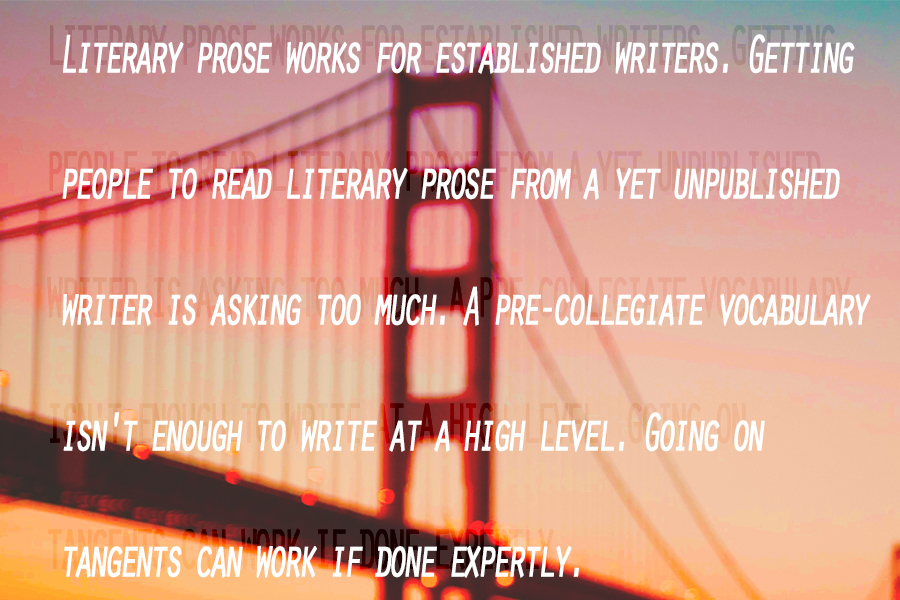
This book taught me a few valuable lessons. Literary prose works for established writers. Getting people to read literary prose from a yet unpublished writer is asking too much. Chabon used lots of words that were new to me like prestidigitation, opprobrium, and razz among others. A pre-collegiate vocabulary isn’t enough to write at a high level. Chabon frequently went on tangents, devoting page space to the stories written by Clay. Large parts of the book detail the fictional comic book heroes, The Escapist  and Luna Moth. I liked these parts a lot. Chabon made me wish to actually read the comics he described. The Escapist thrilled me. Luna Moth was perfectly hot and written with style. Going on tangents can work if done expertly.


Two books by Gillian Flynn taught me a lot. I’ll start with Gone Girl, the one I read first. The story started with Nick Dunne waking up next to his wife, Amy Eliot Dunne. We follow along as Nick left their house that morning. We watch the events as he discovered his wife is missing. Nick’s experiences through the investigation is chronicled. In the meantime, we read through Amy’s journal from the night they first met onward.


Gone Girl was amazing. Flynn found a way to justify an incredible amount of backstory. In Amy’s journals, we are looking for an evidence that Nick is capable of killing his wife. Amy left a series of limericks as part of this anniversary tradition they have. This allows Nick a chance to relive even more memories as he follows Amy steps before her disappearance. Throughout Amy’s journal, she wrote a series of multiple choice questions. After all, she was a quiz writer at some magazine. The story is allegorical to the dynamic within a marriage. Strong writing brought the story through easily to the reader.

gg

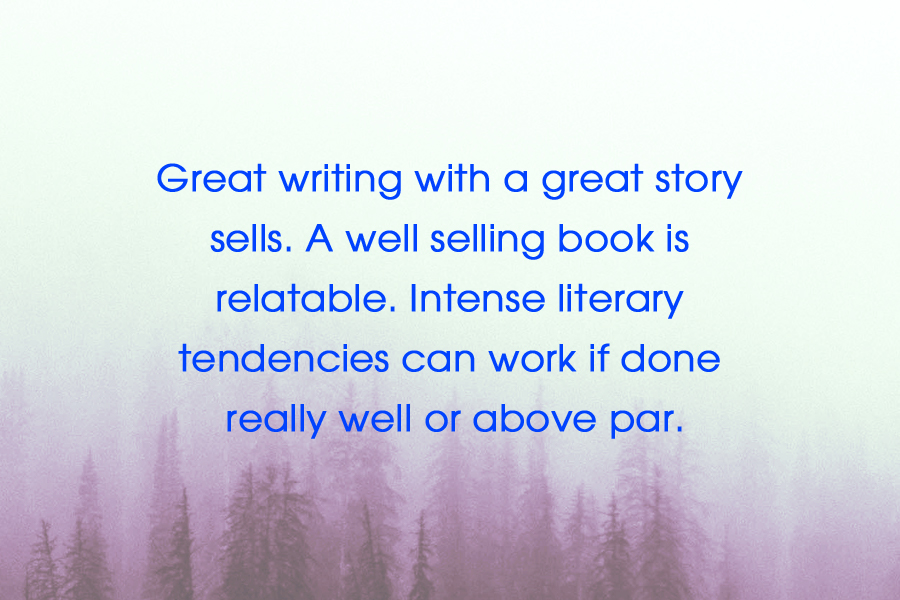
This novel taught me a few important lessons. Great writing with a great story sells. Gone Girl was on the New York Times Best Sellers List for over two years, won two awards, and was made into a movie. A well selling book is relatable. Intense literary tendencies can work if done really well or above par.


Sharp Objects is about a young reporter returning to her hometown, to follow-up on a serial murder investigation. Going home, brings back a lot of old memories. Everything is creepy in a way that adds character to a small town. The end is nearly impossible to figure out.

sharp

A few lessons saw me through to the end. There is place for complicated sentences in modern, non-literary fiction. Feel free to include introductory, dependent, independent, and concluding clauses as long as the coherence or smoothness doesn’t reduce. Details are okay if it adds something like a feeling you want to convey, hints, misleads, or does something to make the story better. It doesn’t matter who you are, traditionally publishing a first book over 200 pages is incredibly difficult, if not impossible without something else going for you. Gillian Flynn was a reporter for Entertainment Weekly and her first book is 200 pages long.


Station Eleven is a literary science fiction novel that redefined what sells. The story follows the creator of a small batch comic titled as Station Eleven. The comic was about a lone doctor on space station destined for destruction. We follow the comic author’s life through her relationship with a previously famous actor and beyond to death. The actor connected with a young girl on the set of a play. We follow this young girl after some type of apocalypse. Another character is followed through the cataclysm. Basically a literary novel without an easily defined plot but gives a feeling of actually being there.

station 11.jpg

Emily St. John Mandel is a great writer that has a lot to teach. I remember this one sentence that, simply put was amazing. I read this one sentence that perfectly summarized the work duties of an executive assistant. This sounds boring but encapsulated in a richly complex sentence made it interesting beyond belief. After reading the paragraph, it was stunning to see it was all of three sentence. I have a ton of work left to be that good, especially that smooth. Literary novels follow characters, things, and places through a series of event to shed light on existential questions. Keeping the reader oriented can be difficult, but when it works, you can do anything.


The Goldfinch follows the young Theodore Decker after his mother dies in a tragic museum explosion. He spends a years with his gambling father in Las Vegas. Then we see years an apprentice and an antique dealer. Finally married to a beautiful woman. Through it all, we feel his emptiness and longing for what he lost all those years ago.

gold2

This book is dense. For maybe the first time, a modern book required me or the reader to slow down and take in everything. I can’t imagine writing and editing a book for ten years. My motivation wouldn’t survive that long for one project. Literary novels create experiences with beautiful imagery. This can be done by making the ordinary pretty or choosing events that allow lavish imagery. Donna Tartt does this through a series of drug experiences and smoky, dark scenes with nothing happening very fast. There is literary and then there is great literary.


Infinite Jest is the longest book I’ve ever read. David Foster Wallace wrote a book that’s a traumatic experience to read. It incorporates a little of everything from drug addiction, depression, film theory, world diplomacy, tennis, and North American diplomacy among other things. The story follows a family that owns a tennis academy, a rehabilitation center just down the road, and a meeting between American counter-intelligence agent and a double agent from a Canadian terrorist group. That meeting got annoying with the frequency Wallace returned to it and its length. The use of parentheses to denote the antecedent of pronouns was frustrating. The ending left me disappointed. There was such a long build-up and the ending was outside the time frame of the prose. Wallace doesn’t hold our hand through to the end and shoves us to figure it out. The length made me really struggle to put the ending together. All that aside, Wallace gives us an almost unabashed look into the human psyche at its worst.

infinite-jest

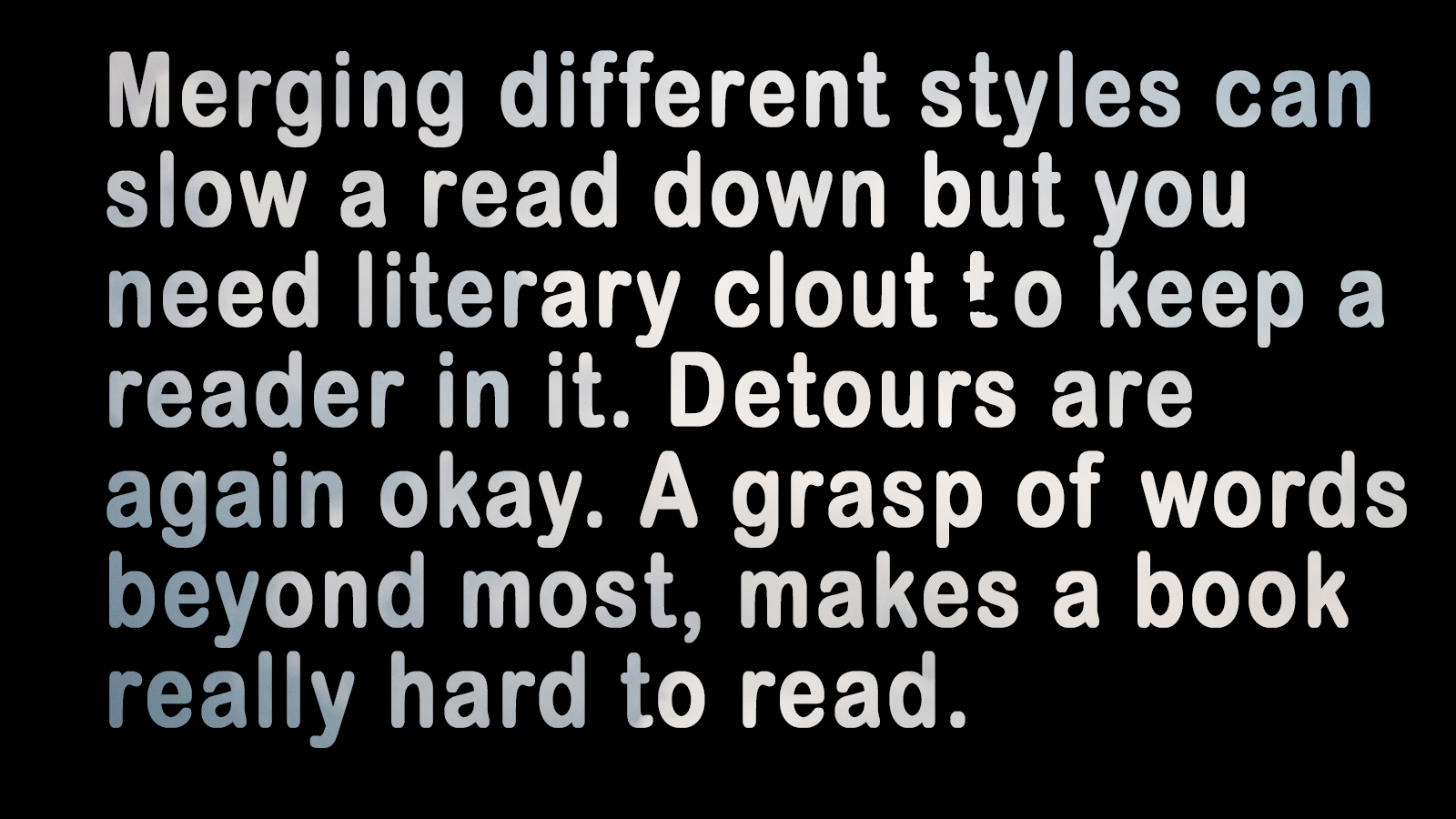
Wallace gave me a few irreplacable tips. Merging different styles can slow a read down but you need literary clout to keep a reader in it. Infinite Jest uses ebonics, first person, third person, monologue, footnotes, and various other styles throughout. Detours are again okay. A grasp of words beyond most, makes a book really hard to read.


Then we have Storm Front (Dresden Files #1). A wizard/private detective investigates two different cases. The plot is rote. The two cases have to collide right? Add in wizardry, a police detective, a overseeing wizarding board breathing down his neck, a few rules about what’s allowed, and dark magic to get Strom Front. The language simple and easy to digest. The wording steps out of the way and puts the story front and center.

storm-front

I learned a lot that supports everything I’m getting into. Simple construction works really well. Readers like familiarity. The woman characters are femme fatales with a slight variation, usually. We have a hot reporter with a pen instead of a gun. A pretty detective with a badge and gun. A true femme fetale with information and no gun. I really liked a scene where the wizard questions the woman with information. Butcher does a really good job describing her smoky, contralto voice. I did something like that but not really well in my first book. I need to keep working on maintaining a feeling for an extended period of time. Keep the action coming and use the lulls wisely. Choose when to give exposition and what to say with care. Add something new to the genre like the present day, vampires, and sex as used by Butcher.


Reading is invaluable to a writer. It has always been a big part of my life and will continue to be. These books were read over the course of a year. Another year of reading will bring more lessons and interesting worlds. I look forward to it. Come back in two weeks for the next post. Until then, Graham Kar out.


GK

subscribe button