Vulnerability for a Genuine Connection with your Reader

The advantage of letting people in through writing.

Connection is a scarce resource.

New ways of connecting like social media, the Twitters and Facebooks of the world simulate connection without delivering.

It’s time to return to what worked in the past, writing.

The opportunity for deep connection is slipping away. Reading is the only way to get that back.

Connecting with your reader is the purpose of publishing writing.

Connection is the purpose of a human life.

It’s the innate spark that has driven everything good we’ve ever done. Writing, scientific discovery, and cooperation are manifestations of that desire.

Being alone is one of the most painful things we can experience.

As writers, we’re in a unique position to fill that need of connection.

Being vulnerable is how you make that happen.

Connection requires the strength to be vulnerable — letting people into your life with the possibility of getting hurt.

That’s one of the things a writer must overcome to connect with readers.

The process goes something like this.

The people reading your work feel close to you.

Readers open their heart and soul to you, because you have already done the same.

Then your message gets across to be interrogated and verified.

If the message pans out, the reader interrogates their life with it.

We’re wired to seek out connection.

Being vulnerable is how you get there.

GK

Repackage your Truth to Write Something Great

The reason to “write what you know”

Write what you’ve lived.

Passion and motivation accrue when your writing something you believe to be. Your lived experience is a powerful tool that gives you insight where few others have it. Because each life is different and everyone is slightly different, we come at things from different perspectives.

People read to find insight about human nature.

That’s why fiction and memoirs sell as well as they do.

Share what you know better than anybody else.

People want truth, and truth comes from life. The life you’ve lived means something no matter how you’ve repackaged it.

Fiction shows a truth about life by changing the situation.

Making the facts stand out like they never could in real life. Sometimes real life can do that too.

You can’t choose your life

You sure can choose characters, a setting, and a plot that shows your truth.

Writing on Medium (where this originally appeared)

Personal stories of facing adversity do really well. That’s the focus of Medium at this point. Fiction is hidden in some back corner.

People come here for stories about people changing

Being true to yourself does really great here, because the community is supportive in a way few places are across the web. Medium is growing a lot still. That has to mean something. Sharing stories of life, of your truth bring people to you. That’s the story Medium tells us.

That’s a formula many prolific writers on Medium employ.

They write personal stories and other types of posts like poetry, fiction, thought pieces, and interviews. Like Meg, Abby Norman, and E Price — the examples I remember off the top of my head.

Put your truth out there and people will come.

GK

Slaughterhouse-Five and The Handmaid’s Tale: Things to Like

Reading can show our lives reflected in a myriad of ways.

I have this allergy to classics.

Most books written before the 1950’s that is. I find sleep creeping up on me like an unfulfilled need. That’s after having a full seven hours sleep and not feeling tired at all. Something about them is dull enough to put me to sleep, and it’s just me. Unlike some, a book before 1950 takes me to sleep quicker than anything else.

Slaughterhouse-Five

I whizzed through the first chapter or two. Those chapters were Vonnegut trying to remember what happened in the war and preparing to write. There was this great exchange that setup the themes to come.

“You were just babies then!” she said.

“What?” I said.

“You were just babies in the war — like the ones upstairs!”

I nodded that this was true…

“But you’re not going to write it that way, are you.” This wasn’t a question. It was an accusation…

So then I understood. It was war that made her so angry.¹

Then the story started. Throughout I was confused about what was going on. The non-linearity threw me off.

Billy Pilgrim has come unstuck in time.

Billy has gone to sleep a senile widower and awakened on his wedding day. He has walked through a door in 1955 and come out another one in 1941. He has gone back through that door to find himself in 1963. He has seen his birth and death many times, he says, and pays random visits to all the events in between.²

I ended up grouping the events of the story into parallel stories.

One was the war. The other was after the war. And the third was being abducted by non-linear aliens. That reminded me of Arrival. The movie is two parallel stories that each follows a linear progression. It’s much easier to follow than the leaping Vonnegut did. That makes me believe I didn’t get everything out of reading Slaughterhouse 5. A whole bunch of symbolism was lost on me.

I kept trying to find a rationale reason for this time hopping.

Maybe he’s in the POW camp imaging his possible future. The more likely scenario is he’s an old man looking back on his life. That distracted me from looking at other more important things. The skipping around was a way to give the reader moments away from the conditions suffered in the POW camp.

A few comical moments made me laugh in the beginning.

But lost their humor. Now, I suspect that was intentional. The dark humor came when some thing dies, and Billy thinks So it goes. It speaks to the universality of death, whether it be fleas, cows, or people.

The Handmaid’s Tale.

It’s about an alternate divergence of history in the 1970’s.

Society regresses to an ancient state. Woman became a possession of men again has it hadn’t been in a while. The pressure on the society was great enough to allow it to happen. The story looked almost prophetic seeing the way history progressed from 2001 onward. The adoption of the Patriot Act in a time of intense pressure from the outside.

Some things in the book made me angry.

Like the way anything could be used to further a decrepit political ideology. The subjugation of a weaker group by the numerous and privileged. The impeachablity of the dominant sex and blaming the subordinate sex. The society described in The Handmaid’s Tale annoyed me, like the backwardness espoused by ethnocentric people. The subjugation of woman by other women was disheartening. Though that is actually a fact a lot of the time. Like the installation of a puppet government by a foreign government. The foreign power chooses a native figurehead and puts them in a position of power over their countrymen. The use of a select portion of the Jewish people by the Nazi’s to police the ghettos set up in Nazi Germany. And the symbolic position of people that had no real power.

The Handmaid’s Tale is about surrogacy without modern medicine.

That basically means state sponsored rape of woman with successful pregnancies and multiple marriages. The fact it’s government sponsored and enforced leads to normalization of rape. Reading through those scenes made me confused, because the Handmaid telling the story was so distant all the time. During the trauma that makes sense, but after it’s confusing. I don’t think society as a whole was ready to have an honest discussion about rape when this book was published.

A few passages resonated with my lived experience.

I’ll list those and explain their significance.

In reduced circumstances you have to believe all kinds of things. I believe in thought transference now, vibrations in the ether, that sort of junk. I never used to.³

I see this happening in my life.

Living with a limiting condition like Muscular Dystrophy is another version of reduced circumstances. That probably had some impact on my belief in meditation. And how ready I am to believe things based on very little evidence. I need that illusion of having control more control than I do with meditation and karma, so the situations I find myself in aren’t quite as helpless as they really are. Control is what we want in life, but the only way to get that is controlling what you can and letting the rest go. Holding control over everything means you have a little control over a lot of things. When all we really need is great/er control of the few things that matter, like our view of the world, and the way we move through it.

In reduced circumstances the desire to live attaches itself to strange objects. I would like a pet: a bird, say, or a cat. A familiar. Anything at all familiar. A rat would do, in a pinch, but there’s no chance of that.⁴

I hang on to things I’ve made.

Especially with abilities I no longer possess like drawing, writing with a pencil, or walking. And the projects I devote my limited time to like the stories I’ve written. When people lose a little of the autonomy that those around them have, they cling to the limited things that they have control over.

It’s impossible to say a thing exactly the way it was, because what you say can never be exact, you always have to leave something out, there are too many parts, sides, crosscurrents, nuances; too many gestures, which could mean this or that, too many shapes which can never be fully described, too many flavors, in the air or on the tongue, half-colors, too many.⁵

I include too much detail.

This is something I encountered in the beginning of my writing journey. My stories were too muddled with extraneous description making it completely uninteresting to read. Some blog posts I’ve written were like that a year ago. Choosing specific details, the right details separates first-hand experiences from imagined situations. But choosing that is a mental process so replicable. That’s what using senses in your writing is all about. Choosing the right details to put into writing the transport you there, and make something more real than fiction ought to be.

You can only be jealous of someone who has something you think you ought to have yourself.⁶

We want things we believe we deserve.

When things don’t happen how we like, we fixate on those qualities we hoped to attain but failed at. Then we see it everywhere around where it wasn’t noticed before. Jealousy happens when we want things we can’t have. Other people that have those things become the focus of our jealousy. That reminded me of the rampant jealousy I feel, because there’s so much I can’t do that I ought to be able to do. You can be jealous of anyone if they have something you believe you’re entitled to. The costs of those things are lost, just the object is remembered. Like writing everyday requires giving up other things like reading articles, social media, checking e-mails, listening to music, or responsibilities. People just remember the accomplishment of making progress. The cost is payable, and the benefit is attainable.

The arrival of the tray, carried up the stairs as if for an invalid. An invalid, one who has been invalidated.⁷

People can be invalidated by taking away their autonomy.

But an invalid suffered from an injury or disease. That was a powerful reminder of the fact that people can only take away what you allow them to. I have always been impaired by Muscular Dystrophy. My struggle has been making people see beyond my physical appearance to the stuff inside. I’m like everyone else on the inside. The only thing wrong with me is the external — my muscles are weak. Fighting for what I am, the person inside to be seen has been with me my whole life. What other people think about my ability doesn’t change the facts.

God is love, they once said, but we reversed that, and love, like heaven, was always just around the corner. The more difficult it was to love the particular man beside us, the more we believed in Love, abstract and total.⁸

Love is a concept that we need to believe in.

It’s a security blanket that we will find this magic person that makes us feel loved the way our parents loved us. It’s like hope. It’s like God. It’s like dreams. Those concepts are what we need to keep living life. They are the promises that keep us going. Without them there is no life — there is on death — there is no meaning. Things that are necessary don’t fade away. They endure. They become justified no matter the circumstances. They grow to meet challenges. They are immune to the wear of time. They don’t fade away. There is no recourse in life but to believe, to have faith that they are always right and pure. Then to see things just right so that the illusion never blinks out of existence, because they are necessary for life.

I’m a refugee from the past, and like other refugees I go over the customs and habits of being I’ve left or been forced to leave behind me, and it all seems just as quaint, from here, and I am just as obsessive about it… I become too maudlin, lose myself. Weep.⁹

Things might change but there is always something left of the old.

Change isn’t to wash clean a chalkboard and write something new. Change is painting over an old masterpiece and leaving bits of the old in place to marry with the new. Things don’t vanish. They are reinvented, tweaked, and damaged, but they never disappear from existence no matter how we cling or try to forget. Things never leave the world. They are remade over and over. Transformation isn’t transient. It’s the constant state of life. Even death isn’t stagnation. It’s a redistribution.

That’s all I have on these two great books.


Hope you enjoyed reading. Please clap if you did.

References

  1. Vonnegut, Kurt. Slaughterhouse-Five (pp. 18–19). RosettaBooks. Kindle Edition.
  2. Vonnegut, Kurt. Slaughterhouse-Five (p. 29). RosettaBooks. Kindle Edition.
  3. Atwood, Margaret. The Handmaid’s Tale (p. 105). Houghton Mifflin Harcourt. Kindle Edition.
  4. Atwood, Margaret. The Handmaid’s Tale (p. 111). Houghton Mifflin Harcourt. Kindle Edition.
  5. Atwood, Margaret. The Handmaid’s Tale (p. 134). Houghton Mifflin Harcourt. Kindle Edition.
  6. Atwood, Margaret. The Handmaid’s Tale (p. 161). Houghton Mifflin Harcourt. Kindle Edition.
  7. Atwood, Margaret. The Handmaid’s Tale (p. 224). Houghton Mifflin Harcourt. Kindle Edition.
  8. Atwood, Margaret. The Handmaid’s Tale (pp. 225–226). Houghton Mifflin Harcourt. Kindle Edition.
  9. Atwood, Margaret. The Handmaid’s Tale (p. 227). Houghton Mifflin Harcourt. Kindle Edition.

GK
A Friend in Need of Comfort

This is short about friendship.


We were supposed to be friends like before — before she’d gotten serious about dating. It was apparent we wouldn’t be best friends anymore. It was hard being best friends with a girl, especially if you’re a guy. Everyone thought we were together. It didn’t matter that Claire already had a boyfriend —seeing us together was enough. It was annoying.

Claire rang the doorbell. We were going to talk face-to-face after months of texting back and forth. It had to be something big like the bf.

Claire was in a trench and jeans. Pulling her inside, I got us a bottle of wine like she’d wanted. I’d always thought her bf, Adam wasn’t good enough for her.

“Adam is remote. I have no idea what he’s thinking. The sex is great, but that’s not everything. Something is missing.”

That was a touchy spot for Claire, not getting what she wanted — wondering if it meant something.

“I don’t know what it means. He shut me out.” Her eyes were wet.

It made me angry. Why are you hurting Claire like this, Adam?

Claire kneaded her eyes and tried to smile for me. That hurt, like she stabbed me. I didn’t want her acting for me like every other man. I went and sat next to her.

“Claire. You don’t have to bottle everything up to protect me. I’m your friend. Nothing you do could hurt me.”

She looked at me with a sad smile. I put my arm around her. Claire sobbed. I kissed her hair, whispering the words she needed. Her tears quit, and she looked at me. Sadness was there, but the dread was gone. In moments like that, I wanted to kiss Claire like the world depended on it, but I wanted her friendship more than her body.


GK


subscribe button

Photo credit: Photo taken by Shanon on Pixabay.

Remembering Things Lost Forever to Fate

This is a short story about an ending.


We walked through the garden interspersed with topiaries and dramatic lighting. It was dark. Everything was as it should be — the pyramid of latticed glass and baroque buildings ahead of us.

The grass ended with stone. A scream went through the square. My heart jumped into my throat. We froze, looking to that sound and things happening — masked men around the grounds — far away yet dangerous. I held Jack’s hand tighter. Something sailed into the hands of the masked men. Jack pulled me along. Looking over my shoulder, I saw what was thrown over — guns.

I spun my head and felt a splash of cold on my face. We sprawled on the ground as people streamed by. “Jack honey, we have to move.”

He squeezed my hand a little.

I looked at him on the ground next to me. My face drew tight, and my eyes widened. I felt the wetness splashed across my face and drew my fingers back red. Jack sucked in great breaths of air as blood trickled out from his chest. We were in the open before the pyramid.

Holding Jack head, everything around exploded with gunfire. The glass shattered and stone erupted, evading the rush of bullets. My world was the tiny bubble that contained Jack for the moments his life slipped through my fingers. “Hang on, Jack. A little longer for me? Please, Jack.”

It was too late. His hand went limp in mine, and he was gone. I went through that day again and again, pulling my hair out at what we could’ve changed. Someone grabbed me round the middle, and took me into the pyramid.


GK


subscribe button


Photo credit: Photo by Pixabay on Pexels


Memories of Love: A Missed Opportunity

This is a short story of lost love.


It was a dinner party at Ben’s, a bunch of guys from Amherst together again and our girls. We were all that age — between maturity and adulting. I was the dude without a woman in tow. Everything was good being single. There wasn’t someone giving me judgmental gazes like my mother. There was hooking up and enjoying life. Everything was right with the world being alone most nights. Every so often, I had a hot girl in my bed.

Stagnation wasn’t in my vocabulary. That’s when I looked at Ben’s girl. Sonia looked familiar. Familiar like a girl you’ve been in bed with — dark hair to the middle of her back, green eyes making me wonder, and lips I remember. I could see it. How she darted looks at me and licks of a smile. She was a girl that lay in my bed — no question about it.

She was with Ben now.

I wanted her. Sometimes limits feed your hunger. I wanted a bite if not a kiss. I looked into her eyes and remembered.

It was rainy. Delicious food filled our bellies with warmth. The cab stopped outside my brownstone. The rain pelted us wet by the time we were inside. I didn’t want our usual bottle of wine. I held her wet neck, and we kissed. I carried her up the stairs to my bed with her playful squeals filling my ears. The light rain struck a beat on the windowpane and the gorgeous Sonia smelling of rain. And now we were sitting a table’s width apart, sneaking looks. I wanted her more.

It wasn’t to be. We could never be together with Ben dating her.


GK


subscribe button

Photo credit: Photo by Max Bender on Unsplash

Betrayal by the Things we Love Most

This is a dreamy short story.


The boundless ocean stretches ahead. Its jagged, mirror-like surface reflects back the pale orange sun. The boat moves at speed through gently rolling waves sending up a spray of fine mist. On every conceivable surface the salted droplets land, a coating of flaky, crumbly mineral grows. The salt covers my lips and arms with crystalline layers. My grip on the railing provides purchase against the cool wind and damp. The sun helps too. Water maids accompany me on this journey, swimming in the wake and ahead of the bow in the form of dolphins.

I peer to the upper deck, flying high above, well over the worst of the spray and wind. Perched upon this, my constant companion whom I couldn’t do without. She gazes out past the local scenery with the aid of binoculars, to some far off wonder beyond my grasp. From that outlook, another horizon is visible a bit farther than my own. She takes a more pedestrian view by carrying the eagle-eyed tool off to her side. Her other hand forms a shade visor over gleaming eyes. A shift in the oncoming rays turns Claire’s body into a silhouette of a goddess on the harsh radiating light of our life bringing sun.

She comes down from her heavenly perch, nestled upon the higher deck. The ease and grace with which she moves in nothing short of perfection. Claire is down at the deck to exchange words with me. The sweet sounds of her irresistible intonation wash over me. I hear her words, but that’s not everything. This exchange has the surprising quality to put me at ease.

Claire leads me to the deck cabin by her usual mannerisms — consisting of feather light touches on the inside of my palm and arm — knowing exactly how. The deck cabin bolsters a pendulum sort of door, swinging back and forth with the lightest of breezes. Claire pushes the door aside as I miss her contact for a brief moment, moving through the filter screen of a doorway. The door swings through on its pendulum arc.

In that instant, Claire disappears into the body of the ship. I push through the door expecting the truth of Claire behind, yet she is not to be seen in the darkened chamber. I walk through the room looking for her only to be disappointed. Claire is nowhere below or above decks. A looming dread comes over me. The rhythmic slapping of the door ends with a loud bang. I look back to see nothing — an empty wall in place of the door.

I look for an escape route from the dark, desolate chamber entombed within the ship. The transom windows are inches beyond my outstretched fingers. The blackness is held at bay by late evening light coming in. Chalk markings of an indecipherable and crude tongue graffiti the walls. Paper underfoot crumples and crunches with each step. I sink to the ground in a state befitting my current desolation.

Wetness encroaches my battlements from every front. A deep red sludge, a curse adding to my sad state. With each passing breath and moment, my heart fills with revulsion. The impending creep of the fluid sends me up and away. The red concoction comes higher, soaking into more of the paper under footing, turning it into a blood red mush. I end up tasting the fluid to verify my suspicion that this is blood from some massive creature.

The transoms let in something else, filling my prison just a bit faster. The golden amber liquid comes in by waterfall. The intense smell of liquor wafts up into my nose. The liquid flows in with the goal of drowning me as sewer rat. The onslaught goes on without a sign of relenting, intent on my destruction. There must be a method escaping my thoughts that can rid me of impending doom.

The transom is my salvation. I get myself soaked through and through grasping desperately at the window inches above my attempts. Wandering from light to light, I find a step where there is none to reach my salvation. I pull myself up with as much strength as my frame can manage, up to the deck. Halfway up, a tug on my leg slides me back. The next so forceful, my head reels up into glass transom. This, my end.


GK


subscribe button


Photo credit: Photo by Chris Lawton on Unsplash

Finding the Things You Want: Middle School

This is a short story about making friends.


I was daydreaming, sitting there at my desk, watching the other students, and imagining what their words meant beyond the words themselves. That was my typical day in middle school. I was the odd one out, because I wasn’t the same as everybody else — a social in-adept — a stranger in the ways of my age.

That’s when I saw her. It wasn’t like she was the most beautiful or the most popular. It felt like I knew her from across the room though. We had gone to the same schools for years. There wasn’t any back and forth — we’d never talked.  I wanted to be right there, in the thick of that conversation. It should’ve been easy, but they were talking about baseball.

I was out of place. I never fit in anywhere, because I was scared to be myself. That ruined me from the start. And it would take years of course correcting to change things.

That was the first of many encounters. In hallways, across the cafeteria, at football games, and the one class we had together — memories that haunted me and missed opportunities I’d never have back. If I wasn’t anti-social to the extreme, I had an in. I was smart — not study group smart. I was still a weirdo that couldn’t meet muster. The sidelines was where I would remain years on down the line.

Then things started to change. See, I had a few friends. I joined their study group. The hand of fate smiled on me, and I was in the study group with that girl the week after next.

Leaving things to fate was how I survived being my own man in a sea of conformity.

THE TRUTH:

I hid from the world, never allowing even those I knew best backstage passes.


GK


subscribe button

Photo credit: Photo by chuttersnap on Unsplash

Finding Love Again on a Rooftop

This is a short love story.


It was a party in the City. Some miracle got me invited. It was one of those rooftop affairs, not that I’d ever been. Strings of mini-lights hung overhead. Music tickled our ears like the cool night. It was me and a few girlfriends in the middle of the roving throng.

That’s when he came over. Tina knew him. He smiled like a dozen stars, and I was seeing spots. Brad. Somehow the minutes ticked by, and we were alone surrounded by strangers.

“You look sexy as hell. Megan was it?”

A splash of heat rose to my face with my laugh and how he made me feel. His words would’ve been awkward, if I didn’t like him already. There I was, alone with the honest, handsome fellow. My yes was meek as a field mouse in the general din.

“Want to dance?”

“Anytime.” We laughed. Everyone was dancing, so why shouldn’t we?

How did I know Tina? What a wonderful party? What a night? It was quite something.

My girlfriends were absent or giggling at our flirtations. But it wasn’t bad in the hands of handsome Brad. It was something great.

We danced and danced, then drinks on the rooftop. It was the perfect night up there, above the bustling street. Our hands met after signaling back and forth. We turned to each other minutes later and tilted our heads. As our lips met, possibilities flashed before my eyes.


GK


subscribe button

Photo credit: Photo by Patrick Tomasso on Unsplash

Finding Love in the Chill of Winter

This is a short love story.


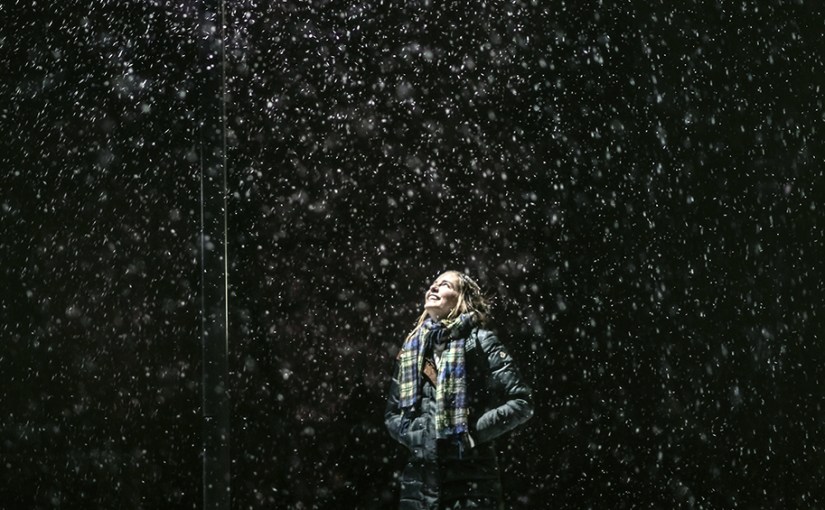
The snow drifted down — mini lanterns adrift on the wind, falling all around them until a fateful landing on the ice below. Glowing electricity cast light as well as shadow into the night where they stood on a frozen pond.

Her laughter filled the silent night muffled around them. Ronnie made her laugh like so few could. She could see it. A life filled with joy at every moment. But that wasn’t them yet. They were gliding along, holding hands, but apart — minutes away instead of a reach most nights.

The wind tore at them like the expectations of others — the pressure of ticking towards a happy life. Everything was chaos except the world created between them. Everything was simple inside their bubble of ebullient, jubilant love.

The darkness didn’t matter as they provided the light.


GK


subscribe button

Photo credit: Photo by Annie Niemaszyk on Unsplash