Story Engineering: Getting Down to the Story Mechanics


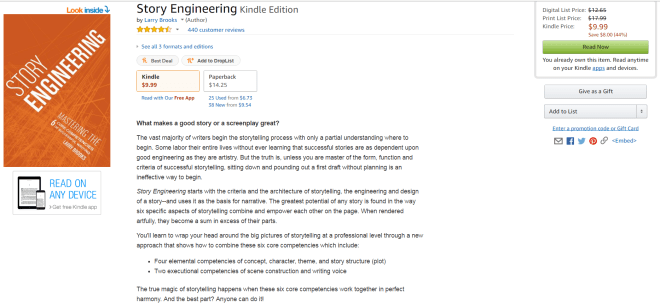
Larry Brooks is a published author that has writing classes/workshops. In Story Engineering, he shows us what he teaches his students about writing fiction. Apparently, writing a screenplay is very easy in comparison. Books out there detail the rules required in an acceptable screenplay. Larry Brooks has brought that over to fiction writing. If you ignore the condescension of organic writes, the book brings a needed insight to novel writing.

1

Story Engineering starts with an argument against the formulaic nature of planning out a story using his components. The difference between art and putting matching things into a formula is the whole is greater than the sum of its parts. I wasn’t sure exactly what that meant while reading it. That’s one of the few things not explained in Story Engineering. I figured out a possible explanation. The various story elements, concept, story structure, character, theme, writer’s voice, and scene construction have a synergy between them. Each element builds on another. For example, first person, solitary confinement, weak mental state, and being alone is inhumane. With first person, we are with the inmate at all times. There’s minimal interaction with other people. Add the weak mental state and there’s a compelling story. Add examples of what other inmates in solitary confinement come out as. That makes a pretty good story right?

2

Concept is the central question of the story. Story structure is the pacing of the story. The author does a really good job of getting this point across through the book. What plot event should happen at certain points throughout the story? Several movies and books are discussed as examples. Every book and movie I remember follows the plot events. I’m not sure about the timing yet.

5767091_orig

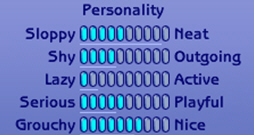
Character is presented as a personality selector you would use in The Sims. Different characteristics that can be tweaked to show the universality of humanity. Figuring out how each characteristic affects the others is where the art part comes in. Then the character arc. That was completely new to me.


I use a few lines of research to understand how characters operate. First, observing people and imagining what goes through their heads. Talking to people and looking for the motivations. Deeply analyzing my psyche through meditative practice. And method acting in my head. What would this character do if that happened?


Theme is the meaning behind the story. The story can give an opinion or explore a question. Figuring out what to say helps put it into the novel.


Writer’s voice is something that needs to be discovered through writing and trying different things. Scene construction states each scene has a mission. The scene needs to be short enough to accomplish its mission.


Reading Story Engineering will forever change my novel writing. I was already close, and now I get it for the first time. Larry Brooks knows his stuff. Great book Mr. Brooks.


GKsubscribe button

The Benefits and Nerves of Writing Groups


This is a guest post from my friend, Cori Nelson. She’s a writer of children’s books and middle-grade novels. Right now, Cori is writing her thesis. She traveled halfway around the globe to continue her writing career. Check out her WordPress blog and scroll through her tweets if you’re so inclined.


Writing is a lonely business. That seems like a pretty generic statement, but it’s true! As a writer, you sit alone with your computer or notebook and argue with yourself over and over and over about plot and grammar and spelling. Being trapped in your own head all the time is not only lonely, but it can hinder your ability to make good decisions (not to mention drive you completely crazy). This is why I think every writer should join a writing group.


This year, I’ve been studying Writing for Children at the University of Winchester. Through the course, I’ve had to share my work in progress with others and then receive instant critiques on my writing. As an introverted, I’m-fine-sitting-in-the-corner-by-myself kind of person, I was very nervous about this concept. I remember reading my first piece out, my voice and hands shaky, my brain forcing me to read at top speed to get it over with. But afterwards! After my voice faded away from the room, after the short awkward silence that follows any reading, after everyone stopped writing down their thoughts on the excerpt in front of them and looked at me, was amazing. My classmates, people I had just met for the first time a week ago, went around the room and told me all of their thoughts, good and bad.


wordblock


It was incredible. And it felt so good to share my writing with others and have them not only like and understand it, but give me feedback that was helpful, too.


Receiving the feedback immediately after reading my writing out was great, too, and something that I think makes in-person writing groups better than remote. It’s nerve-racking enough to read your work in progress out in person and getting feedback right away. I can’t imagine the agony you would feel sending your work in progress to someone and having to wait weeks for their thoughts. Plus, as a children’s writer, I like to write funny. There is simply nothing better than reading something you wrote out loud and listening to your group members laugh at the moments you were hoping were actually funny. That’s something you cannot get with a remote writing group.

felix-mooneeram-222805

It can definitely be very scary to share your writing with others, as writing is a very personal thing, but there are so many things you just do not catch when reading through your own work. Your eyes glaze over a missing ‘the’ just assuming it’s there, your brain tells you that a sentence makes complete sense, when really it’s just a jumble of nonsense. Someone unfamiliar with your work, though, will catch all of those things. She’ll notice when you’ve used the same word twice within two sentences and when one character sounds the exact same as another and will ask the all-important “but why?” to a scene that actually, now that you’re thinking about it, doesn’t make a whole lot of sense. Having someone else read your work is so helpful, I can’t say it enough!


All of my classes here in Winchester were designed to have a lecture for the first half and a workshop for the second half. Eventually, I began to yearn for the workshop half of class, especially when it was my turn to read and there was something I was stuck on with my piece and needed to discuss.

chuttersnap-317197

Along with helping you find grammar and spelling errors, and helping you to better understand your own story by asking questions and giving suggestions, a writing group is a great support system. The group I’m in now (that I sadly have to leave in less than a month!) is amazing, to say the very least. It is made up of some of the most talented children’s writers I have ever met. Each and every one of us is devoted to each other’s writing as if it’s our own. When one member of the group has a victory (like hitting a word count goal), the entire group celebrates. When a member has a setback or is doubting themselves and their work, the entire group comes together to reassure them that they’re not a terrible writer, to offer suggestions to help stimulate new ideas, to offer the sympathetic and always appreciated “it’s going to be okay”. And when a member is having irrational thoughts about their work in progress, the entire group is there to help talk them off the ledge, to remind them that an idea had mid-dream is not always the best idea, and that “no, rewriting your entire dissertation two weeks before hand-in probably isn’t the best idea.” talking from experience, here. I honestly had a thought about rewriting my entire book even though it’s due at the end of the month. Thankfully, my writing group members stepped in with some rational thinking to save the day.


It’s important for everyone to have people like this in your life, true. But as a writer, I think it’s even more important because they’ll help you to keep going. As I said earlier, writing is a very lonely business. It is so easy to get lost in your own thoughts, especially the bad thoughts that tell you you’re not good, that your writing is awful, that you should just give up.


JK Rowling got hundreds of rejection letters when she started querying Harry Potter. As did Stephen King before he made it. As did Kate DiCamillo. As did every single author who’s ever been published. And I can guarantee you that all of them had a support system of some kind to help them get through the many rejections. If not an entire writing group, then at least someone who believed in them and their writing. At the end of the day, what more can you ask for?

GKsubscribe button

Book 2: The Characters that Make the Tapestry


The Trouble with Dreams requires really strong characters to pull off the story I have in mind. Six characters that allow us into their lives to see it for what it is. Then we need to peer deeper to understand their inner dreams. Also what factors are preventing them from what they truly, deeply want in life? That’s a lot of weight placed on small human shoulders. Let’s make them mighty.


What prevents people from getting addicted to prescription drugs? A support network. I wanted this place addiction to be stronger than reality. Showing people at various levels of success would do that. I wanted average people for their lot in life. And what’s the best way to reframe addiction in a way that’s new, visceral, and real? Make the addiction instead an experience that’s their dream life incarnate. And there we have the concept.


I needed compelling characters that go through this experience. I started with a homeless veteran with PTSD and cancer. Uplifting, right? Jk. A large percentage of the homeless are veterans. I wanted to make it a choice superficially, but we all know there’s more to it than that. Chris manages his PTSD by limiting stimulus that triggers his symptoms, like sound and movement. He has a family ready to help, but everyday things trigger him. The potential for him to hurt a loved one is always there.


Then we have an ex-con. It started as a male character but later turned into a woman. Getting a job as an ex-con is really difficult. Most ex-felons are black and reoffend. Unable to get a legal job, she returns to the only thing she knows, car theft. I know very little about low-tech car theft. Mix in those wireless key fobs and then it gets interesting. Software defined radio, RFID, Bluetooth hacking, wifi hacking, deep packet inspection, copying packets and retransmitting. Computer stuff. Never actually done it. I know the general principles and the thought process. She’s trying to be reunited with her daughter.


Then we have Elise (Lotus Elise comes to mind). Elise is a high-end call girl. The company keeps employees under tight control by getting them hooked on prescription painkillers. I wanted Elise to have surrogate relationships with her clients. I also wanted the story of how she got there.


Then we have an author. Michael wants to publish a romance novel, but his first book is a tremendously well-selling pick-up artist guide. He’s hung up on a patient he had as a therapist and is nearly in love with his escort. I connected each character to every other to resemble the fact that everything’s connected. Michael stays sane by picking up women for fun. That should work out really well for him, right? Sarcastic.


Then we have a closeted lesbian lawyer. She has a partner that the firm doesn’t know about. Add a nice apartment and a few cats. Her struggle is getting pregnant through IVF. Some medical issues causing it to be very difficult.


Then a millionaire founder like Elon Musk. Supermodel wife and the works.


Finally, we have a psychologist that interacts with all the rest. Larissa Emery is the common thread through the story. I wasn’t clear on her storyline at the beginning. It grew into her suspicion that her husband was cheating on her. She finds the truth and deals with it. Her interaction with her patients (the other characters), help her decide what to do.


I wrote each point of view separately as if writing an independent story without worrying about fitting everything together. I started with Chris. To get the story under 50,000 words, each of the seven parts should be 7,000 words. Chris’s part took 10,000. My word counts would be higher for the other characters. My vision for the story was too big for my goals. I cut back the characters to four. Chris, Elise, Michael, and Larissa. That grew into The Trouble with Dreams. The entire first draft took ten months and now out to beta readers.


GK

subscribe button

Book 2: The Trouble with Dreams

I tried getting Remember, my first book an Agent. That work was the best I could manage then. It was sheer audacity to believe Remember was the correct fit to be published. Since then, I’ve learned so much about writing. I needed something more relevant and approachable. More than that, it needed to be marketable. Would the work be appealing beyond the angle of dropping the reader into the character’s shoes?

That gave me a hit list. A list of things that the next book required. Some givens were already established so far in my writing career. A psychological thriller, futuristic optional, character driven, and involving love somewhere along the line. I also wanted something that’s set in reality, relatable, 50,000 words, and with average characters. Not all analytical scientists. I also wanted a few hangers-on from the Remember Sequel. That ended up as multiple points of view. I also wanted simple, easy to understand prose that allows the story to get across.

I came up with a few ideas/concepts.

1. the Earth is really one big machine that can teleport

2. a ghost sucks life force and vanishes after the people die

3. a cat turns into a human, helped to become a successful human designing cat toys

4. an alien world with varied population, mainly very thin humanoids that neatly float away without gear weighing them down, from high gravity home world chases down criminal just to allow escape

5. snake civilization of high intelligence makes heaters from fire to stay warm and hunt down larger animals  for food

And finally the idea I stuck with:

  1. place addiction

That idea came from a weird place. We all know about addiction to chemicals like cigarettes, alcohol, opioids, methamphetamine, benzodiazepines, marijuana, and various other things. The jargon abounds with these obviously. Let’s extend that to something more like love. Put on your nihilist hat, please. Love is basically an addiction to a person. Being around a particular person you love, triggers a highly complex, not well understood the neurochemical cascade of dopamine, oxytocin, and numerous others. Now, what about a place? Can people become chemically addicted to a place? Yes, if there’s an association or neural connection that links getting high with a specific place. The next obvious question is what happens if the place no longer works or the dosing ends? If a junkie can only get subpar dope, what happens? Well, we have a pretty good idea. What happens when a great relationship ends abruptly? Hate? Confusion? Betrayal? Inconsolable pain? Suicide? Take your pick. Initially, the idea just appeared as if from nowhere. Looking enough gave the root and stem of the idea/flower.

GK

subscribe button

Editing as a Necessary Evil. What Else Could it Be?


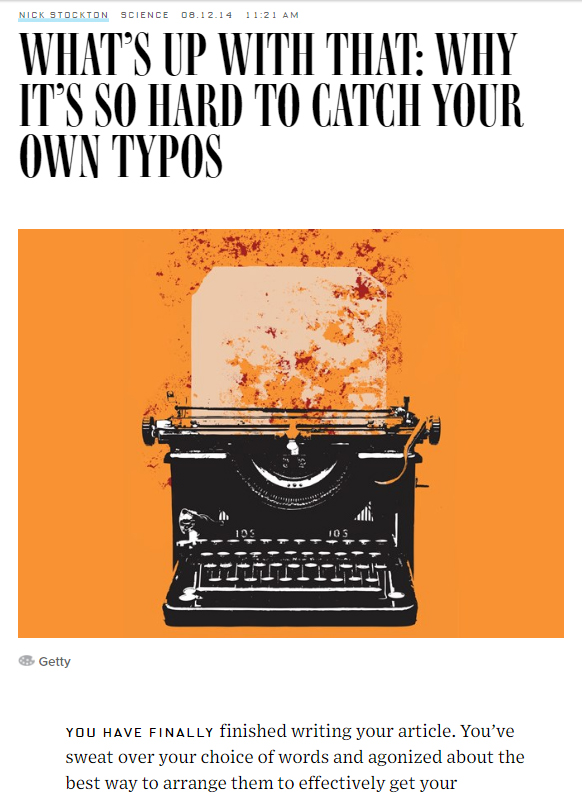
Recently, I’ve been editing Remember. I don’t really like the editing process, but it’s a basic requirement of writing anything. It’s the antithesis of the writing. Editing is a nearly brainless activity in comparison. Editing something over and over still missing some errors is frustrating and motivation crushing. Typo blindness is troublesome. The writer knows the words they intended for the page. Not seeing a few typos each page isn’t really a hindrance for the person that wrote it. This WIRED article does a really good job explaining it. A novel is much more susceptible to typo blindness than say a 10-page research paper. A novel requires a lot of investment. Investment leads to seeing what you want to see, instead of what’s actually on the page.

 wired typos

That’s exactly what happened with Remember. A beta-reader pointed out several typos throughout the book. Unfortunately, I’d already put the ebook and paperback on Amazon. Exactly how that worked out is in an upcoming blog post. I quickly took off those listing. It wasn’t until a few months ago, but I reposted the unedited versions. I’m working on the edits as you’re reading this.

amazon listing 1

After the discovery of numerous typos, I worked out an editing plan. I’d already edited through four drafts at that point. I read slowly through each page twice. Once through a page and then again. Finding typos was easy. The work was time-consuming. I hadn’t yet found a method to stay motivated through more than an hour or so. Two or four pages a day. In a month of doing this, I lost all the motivation I could muster.


The blog has already featured the fruits of my procrastination. I feel too much guilt procrastinating on something completely useless. I have to justify it somehow. That’s how procrastination always starts, as a tangent that can somehow be connected back to the goal. I thought learning Photoshop would help me create book covers that I needed. Then After Effects to make a book trailer. Then 3D modeling for the book trailer. Then game development to practice 3D modeling. This happened in phases between more flawed editing.

wasting time

Through all this, my unconscious was entering the second epoch of my writing style. For some reason I can’t remember, I start thinking along the lines of clarity (an old blog post talked about a writer that showed me the way, Ella Dawson.) I recently read, the biggest mistake of a novice writer is trying to overcompensate for a perceived lack. Usually in the form of over-involved writing. That’s the symptom of Remember. Over complicated prose for confusing and difficult to understand writing. I reasoned if no one can understand what I’m writing, what’s the point. If it isn’t clear, there is no point.


I needed to simplify Remember. I decided to linearize it. Remember started out as two parallel story lines. One was six months ahead of the other. I jumped back and forth. The reader was getting lost. I cut out the boring stuff. Conor court trial and hospital stay were gutted (I’ll post them sometime). I moved the hook later in the novel. I needed a new hook, Conor’s life before the memory loss. What was Conor trying to remember? That should be up on here when I’m putting up the new version of Remember on Amazon.


I wanted the story to be more approachable and familiar. I started switching verb tenses to the past. Earlier in the editing process, I’d already switched out all the verbs for active ones. Tense switching would be much easier. I tried Find and Replace in Word. It was too finicky and took about as much time as the manual way. This verb switching actually helped in the long run. It sufficiently motivated me to cut more of Remember. Cutting from a novel has always been very difficult for me. This extra work of verb switching got me there.


remember cuts
Everything I cut from Remember.


Remember is almost finished. I’ve cut 14,000 words plus, and the novel is better because of it. Listening to music is the motivation I need for editing and typing at times.


Later, guys.


GK

subscribe button

The Things Separating Man and Beast


A fictional construct of the mind.


I hang, suspended by this ball of cast iron bars, high up in some leafy mammoth. A firm, swift tug on the rope holding the cage — through some form of pulley — sends me down from whatever method of comfort I have necessarily employed. I land with the grace of land-bound seal or walrus upon the welt-inducing corrugation of metal bars and air. The descent into the light penetrating fog — beautifully hiding the goings-on at the surface — perpetrates an animalistic, lizard-brain originating rage through me.


The moment of release lies near as through thickening fog a group emerges. The usual screams and yells of fear, anger, and hatred fill the air accompanied by a single wail of deep longing and hurt. From within the heart of the assembly, two people, my parents come forth, tear soaked and still streaming. I extend one arm by the cage, out to them, which they hang to with desperate and strong hands. At this, my ascent to prison and isolation begin as every other day, my endless cycles of suffering continual. Grabbing the bars (seen as fitting) is the recourse of choice. I shake my cage wildly, issuing a guttural sound from deep down. An abrupt drop of this cell knocks me out.


GK

subscribe button

The Schizophrenic or (The Pessimistic Voice that Says No.)

I liked Birdman in general.


The casting added something that felt real to me, Michael Keaton (Riggan). I remember him well from that 90’s Batman franchise directed by Tim Burton, That was the only time I remembered who he was apart from the character. I recognized Naomi Watts (Lesley) from somewhere, probably King Kong. The character that really got me in the story was Sam (Emma Stone). I found the problems in her attractive, probably because I wrote a similar character a few months ago.

birdman-walking

The cinematography drew me in. It was a window into the normal world, walking and how everything looks from that angle. I sit or lay down throughout my day. Every rarely am I looking from eye level of someone standing. The camera shifted in and out of third person to different character perspectives. I liked the closeness to the characters talking. The frustration of Sam when spoke about how outdated her father was became visceral in a way that movies almost never have for me. I sit all the time. People are either right next to me or in front 4 feet away. Imagine never directly facing someone when you talk or being 4 feet away. Looking over railing is impossible for me. I have to parallel park my chair or look at the railing from feet away. This was shown once in Birdman.

_MG_1102.CR2

The rooftop scenes were scary. Heights are down right scary if you can’t stop yourself falling. I can’t. Truth or dare seems so unrealistic and overused. Do people actually play that game in situations of hidden attraction or friendship? That part where Mike (Edward Norton) describes Sam as special, “burning the candle at both ends”, sounds written. The options there are either call it out or change that part into something else. I would have described it differently. Still good.

birdman-flying

The superpowers were interesting even if we couldn’t be sure they actually existed. Levitation, telekinesis, and flight. Everything the fictional Birdman could do. Riggan became so invested in the character, it became a part of him as a voice that degraded him. We all have a little voice in the back of heads, telling us everything that could go wrong. It was an interesting plot piece that severed as an easy source of motivation.


A great movie.


GK

subscribe button

Why I was Silent For Most of My Life


There is no such thing as a born introvert. I may not be able to point out a specific research article or anything to back me up. But I do have my story. Maybe that’s enough.


All of us remember singing or dancing with exuberance as children. An awkward home video of a child singing not very well, what did you expect, not all of us are the next Taylor Swift. I my case it was a magic trick involving a camera cut. I stood there wobbly on my uncooperative ankles. A big flashy toy weapon hung in my hands. The camera cut on cue. I hid said sound weapon in a cardboard box. The camera started again with me holding nothing. A trick of the camera disappeared a toy thing.


Other memories of my singing along of ABBA for some ungodly reason. Dancing around with my sister as she spun me around by both hands. Listening to a ton of the Beach Boys, I had no idea what they were singing about. Something changed when I was around other kids my age. I clammed up and became shy. My parents never discouraged that behavior or modeled something different.
tgott-car-scene

Some traumatic event or more realistically a series of such events leads to introversion. The science suggests nature and nurture contributes to the continuum. I was always the smallest, weakest kid, so very few people were always nice to me. This initial trauma forced a tight limit on the number of friends that felt good. For, me that grew into focusing on a few close friends with the general exclusion of others. This started out well and good. The reality doesn’t sink in during childhood. Without exception these first dozen or so friends moved away, and I never saw them again. That’s a traumatic experience if it happens again, again, and again, and I almost forgot again. These friendships were all from my first elementary school.


The last two-thirds of sixth grade were in a new school. Unlike my old school, there weren’t many black or brown students let alone teachers, wah wah wahh. Let’s say some people didn’t like me very much as the wheelchair bound Indian kid. One kid, Mathias was showing me the lay of the land. Five dollar mechanical pencils were the equivalent of Letterman jackets. I didn’t really feel like investing in one such meaningless mark of social status. I had the cash but didn’t go there.


It was probably stupid considering what I did next. I got a broken Pilot G2 pen from Johnson, fixed the sucker, and never took it out. Then I asked the class jokester to see his whatever mechanical pencil. That kidder told me it was on his desk and I could look at it. Mathias stood right beside him giggling like the funniest thing was happening. I should have seen it as duping delight. That wasn’t on my mind because everyone was so nice. They always looked happy to see me, said Hi insistently, and were really friendly. Like a sap, I cruised down the really long hallway back to the classroom and looked. I was mad. There was nothing there.


I’m not trying to make an indictment here. That single event struck a fissure already deeply ingrained from everything before. Mathias and I became friends. I ignored Mr. Joker from then on. I also think the timing had a lot to do with it.


Just as the Fates turned on me, six months later they saw me back into their good graces. The school district boundaries changed and my middle school wouldn’t be the general vanilla of Osseo. The relative cornucopia of Brooklyn Junior was my future. That’s when my anti-social period began.


I wasn’t looking for friendship any longer. I hit the books for really the first time. I made a few loose friends but no one expect me valued those friendships. My mind turned over this intrinsic human need of companionship to my imagination.

tgott-watching

I watched everything and I mean every single thing going on. Using these observations, I storied their lives as I saw them. As flawed and isolating as this was, it created the components I now use to write. A few interesting characters were Harry, Gwen, and Veronica.


Harry was Mr. Cool. I felt he was really struggling in Honors. Basically, Harry was hitting above his average. His wardrobe needed work but the girls loved him as a friend. I could never really talk to girls throughout middle school or high school. Harry was my hero in that way.


Gwen was someone I always felt a connection to. I never worked up the courage to say a single word to her. The news got around to me through the usual ways. Did I mention the fact I hear like a bat. Eavesdropping was my skill that sometimes helped but usually kept everyone at arm’s length and gave me enough to feel a connection without interacting. Gwen was in the school play. Years later, I found a lot of similarities, more about that later.


Veronica was this person in all my Honors classes. I can probably still describe a ton of things that contributed to my story of her. I thought of her as a girl ahead on the maturity front, more open than most, a social butterfly, and a good person. This has no basis in truth, but I like to think it does.
tgott-detective

Now the part where I un-learn the lessons from all bad stuff delivered my way. I wasn’t that easy, in fact it was the hardest thing I had done up to that point. A few things motivated me to turn back the damage and try again. I lost the physical ability to speak. Very few people know that but there it is. I had stopped going outside and living some time before. The 20’s depression so many millennial’s have, had just ended with the beginning of my fiction writing career. I knew that marketing would be a big part of my future. I needed to escape the cage of my own creation.


This reclamation of my social self began with the common social medium of my generation, the attention trap that is Facebook or fb. I friended anyone I recognized from High School and on back, including everyone I imagined knowing. I didn’t recognize a few. This changed nothing because either the request is accepted or ignored. No friend requests are ever declined.


Then rejection therapy. I said hi to every single accepted friend. It was an internal battle each and every time. After the first hundred rejections things became a tad easier. I found a few people to talk to.


So I’ve exposed the possibility of rejection and faced it en masse. The next step was to learn the social lessons I passed over. I fb messaged like an awkward new-born. I talked about anything that worked. Each message ran a laundry list of worries through my head. Did I say the wrong thing? Should I apologize? This one I agonized over for days and weeks at a time. I projected my conscious into a shade of this friend and searched this new soul to understand what my friend was going through. I agonized, literally agonized this question. I’m not a nice person or a mean person. It isn’t possible to bridge the gap from being okay to being nice with an apology. I spent years ruining friendships thinking I could apologize my way to being a nice person.
tgott-arrest

In time, by that I mean years later, I was ready to break through years of social anxiety with a final Karate chop. I made a list of secrets I had always been terrified to share with anyone. It was the usual stuff like bad experiences and the things you cherish the most. I forced myself to type them out and send them like clandestine missives, all on the very brink of a panic attack. My friends are the greatest, and I hope everyone can say that.


I went from a child having fun and not knowing better to a cynic with too many bad experiences. Now, I’m a speculative optimistic trying to get back everything I denied for years. People need friends. It might be easy to say forget them. If they can’t appreciate me, it’s their loss. I might be easy to say my friends love me. Do they really or just the part you show them. We all can have epic, radically honest, complete friendships. All we need is the motivation, the guile, and the bravery to confront the possibility of loss. Without that, what is the point to this maddening, meandering, mess we call life. There is no life in a vacuum.


Take life into your hands and make it your own. This is one story of my life. Take anything helpful and ignore the rest.


GK

subscribe button

The 25% Solution: Characterization that Shines


Character development is a big part of any story. Each character should be well understood by the reader and distinguishable from other characters. Establishing a strong character starts with a defined back-story. What events and personality traits make the character found on the page. There are several ways to build up a basis for understanding what internal and external factors form certain behaviors.


I employed the method of understanding every aspect of my own personality. Each of these components can be added to others found in the world to create a whole, realistic character. Another way to get there is by observing others and writing out a hypothetical life story that accounts for everything observed. I did this a lot in secondary school, during my anti-social period. Then, there’s the conversational method. Talk with people, have deep conversation, and try to understand this person. Share yourself and it should go both ways. Find someone that is comfortable with it, first. I did a horrible job explaining that.


The novel I’m writing now, there are four main characters. Their story arcs will mimic each other to some extent and have vast differences in other ways. Isn’t that how life is? There is Inslee, the proverbial third-wheel to Sloane and Dominic. Duncan is one of Sloane’s children. Dominic and Sloane have been together for the length of their 2,000 year interstellar trip. Feelings and reactions evolve a lot in 2,000 years. Each character has POV parts that make up the entirety of the prose. Now, the character descriptions of these four characters. We have Inslee, Dominic, Sloane, and Duncan.


Inslee is a sexy, savvy doctor that knows what she wants and is willing to do almost anything for it. She is currently in a situation where, everything she has tried results in nothing changing. From the first time she meet Dominic, she has been attracted to him. This eventually became unrequited love. That feeling would undoubtedly change through the centuries. Remember Dominic is almost religiously devoted to his life partner, Sloane. Inslee’s love, becomes longing for what she can’t have, which makes the feeling of love stronger. Then it makes absolutely no sense to love a person that much. She falls then for the idea of him. Finally she realizes she never actually loved Dominic, but simply what he has with Sloane.


Their relationship is complicated after 2,000 years of friendship, most of it crammed into an interstellar spaceship with a crew of 12. Consciously, she found other relationships to bury her feelings for Dominic. Even though she consciously released those feelings, her unconscious mind still holds onto hope. Unconsciously she sets up situations to accidentally be close to him and test his loyalty, basically flirting without being aware of it.


Each of these immortals has a method to unite body and mind. That is a required part of their existence due to that fact their consciousness is grafted into a new body. Each method of body/mind connection is trained into each blank clone body and practiced by each consciousness. A deep truth is inherent in what the practice is. In Inslee’s case, that is love.


Dominic is a happy go-lucky guy that doesn’t appreciate what he has. He connects with his body by re-experiencing his past. The best way to get him is to deconstruct his relationship with Sloane. After being with the same person for a while, most relationships loose the spark they once had. Each half of a partnership has to evolve and merge for the relationship to constantly redefine itself to work in any situation. I lost you in abstraction there. What about an example?


For that, there’s the history of the relationship between Dominic and Sloane. She protects him during Remember. Dominic helps her get accustomed to their new life without the support she is used to having. They are separated for a time and their feelings intensify. Then Dominic protects her. The feelings of love they have gets old. Based on who they are, two things can happen. Their relationship falls apart or they grow together the only way possible for them. They grow co-dependent in an almost healthy way. Everything is great when both are together and aware of each other. What happens to someone like Dominic when this separation takes place?


That is his central question in this new book. He becomes depressed and at times suicidal. Been there before and know it well. Either way, I am really good at describing emotional states without naming them. I could probably teach a master’s class on that aspect. That’s for another time.


Then we have Sloane. This character is almost a spitting image of me. Sloane is the person I would be if I was alive in this future time period. Sloane is as I’ve thought of her a compassionate person that tries everything to help others. This isn’t the mold for a likable character. It’s more likely I choose the more accurate personality. Sloane wrestles back her emotions through meditation. Meditation is her connection tool. Succumbing to these emotions is terrifying. In the influence of these extreme emotions, she is unpredictable. Showing both sides makes a more likable character. Sometimes she falls into the trap of recursive thought and abject abstraction, and she struggles to reconnect with realty. On other occasions, she falls into the other nectar trap, becoming the person people expect her to be and loosing herself in the process.


Duncan in the son or daughter of Sloane and Dominic. The fusion of his parent’s personalities results in a strong, silent type that meditates in private and deep religious roots. Dominic doesn’t appreciating what he has and along with Sloane propensity for extreme emotions, this results in the silence of their son.


Writing each character through the entire story works for me. Two characters interacting gets tricky, but that’s the trade off. I’ll probably write out a full plan for this one. More story ideas to come.


GK

subscribe button

Thriving in Spite of Reduced Ability


Throughout my life, a few things have remained the same. I have Duchenne’s Muscular Dystrophy, a progressive muscular disease that slowly weakens me. This results in a lose of ability over time.


I have found things that are inherently impossible for me now. Walking is an example of that. Everything else is possible with motivation and hope of getting better. Those are the two things required to be the person you want to be.

In the beginning of my life (before age eight), I knew there was something different about me and didn’t quite know why. Firstly, I started using a wheelchair. The issue of my emigration from India provided another possible source for my differences. Some version of this probably went through minds of other kids about themselves. Everything changed a little after understanding this wasn’t the end of my difference, things would surely get worse.


Let’s be clear about something, I never thought of myself as disabled or damaged. I am just different, like a person with green eyes is different from a person with brown eyes. Never allow another person to define what and how you can do anything. Living without a hindrances is a great gift, but beating what everyone thinks is a greater reward. As with all things, the more effort employed, the better the outcome. This way of thinking changes your perception of yourself. You know for a fact that you are not less able than anyone else. Never put artificial limits on yourself.


I have never attended a support group. Almost everything I’ve gone through deals with itself, apart from the first near death experience. This isn’t an ongoing struggle. This is who I am or who I always was. Nothing that comes your way is beyond your ability to cope, whether that means sharing your story with others or dealing with it in your own way.


This brings me to my experiences with other kids when I was also that age. Every year throughout high school, I along with other kids struggling with purely physical differences attended a gathering. You know the almost forced gatherings setup by well-meaning adults for discussion.


We were asked questions to setup conversation, so-called icebreakers. Would you take a cure if it was available? This is one I remember well. The majority answer was no, excluding myself and one other among the 50 or so others. My reaction to the majority sounds in my head. Why? The answers went something like this: it would change who I am.


I reacted with silent cynicism and confusion. This makes no sense. A cure isn’t retroactive (someone won’t go back in time and cure you at birth, anyway that would make a cure much easier). How can you possibly refuse the cure when it is almost my deepest desire? Then it hit me. My 15-year-old self thought they simply can’t hope because the low likelihood hurts them too much. It helps them cope. The disease is an ingredient of who they are. If the question wasn’t hypothetical, they would stop lying to themselves and say yes. That was what a teenager would think. I stopped bothering with other people as I grew older.


I now think a cure just administers physical improvement, keeping you the same person inside. If the cure would change more than that, the disease has too much power. That is the generally accepted conclusion, a really bad disease limits what opportunities that person has. I admit that without Duchenne’s Muscular Dystrophy, I would have a different job, but I don’t think my personality would have changed that much. I would be more social than I am now, but isn’t that a good thing? Limitations are a bad thing. Never cripple yourself without trying. A battle that is lost in the mind, is pointless to fight.


This post is getting a little too long for one day (hands tired). The key lies in finding your purpose. Take what qualities you have. In my case that is a fighter personality, maximum effort yields maximum results, observation of everything, railing to challenges, and keen memory. Find what you are supposed to do. I am supposed to push through the expectations of others, show them they can do great things, and show them what I can accomplish. Never give up or die trying.


GK

subscribe button