The Benefits and Nerves of Writing Groups


This is a guest post from my friend, Cori Nelson. She’s a writer of children’s books and middle-grade novels. Right now, Cori is writing her thesis. She traveled halfway around the globe to continue her writing career. Check out her WordPress blog and scroll through her tweets if you’re so inclined.


Writing is a lonely business. That seems like a pretty generic statement, but it’s true! As a writer, you sit alone with your computer or notebook and argue with yourself over and over and over about plot and grammar and spelling. Being trapped in your own head all the time is not only lonely, but it can hinder your ability to make good decisions (not to mention drive you completely crazy). This is why I think every writer should join a writing group.


This year, I’ve been studying Writing for Children at the University of Winchester. Through the course, I’ve had to share my work in progress with others and then receive instant critiques on my writing. As an introverted, I’m-fine-sitting-in-the-corner-by-myself kind of person, I was very nervous about this concept. I remember reading my first piece out, my voice and hands shaky, my brain forcing me to read at top speed to get it over with. But afterwards! After my voice faded away from the room, after the short awkward silence that follows any reading, after everyone stopped writing down their thoughts on the excerpt in front of them and looked at me, was amazing. My classmates, people I had just met for the first time a week ago, went around the room and told me all of their thoughts, good and bad.


wordblock


It was incredible. And it felt so good to share my writing with others and have them not only like and understand it, but give me feedback that was helpful, too.


Receiving the feedback immediately after reading my writing out was great, too, and something that I think makes in-person writing groups better than remote. It’s nerve-racking enough to read your work in progress out in person and getting feedback right away. I can’t imagine the agony you would feel sending your work in progress to someone and having to wait weeks for their thoughts. Plus, as a children’s writer, I like to write funny. There is simply nothing better than reading something you wrote out loud and listening to your group members laugh at the moments you were hoping were actually funny. That’s something you cannot get with a remote writing group.

felix-mooneeram-222805

It can definitely be very scary to share your writing with others, as writing is a very personal thing, but there are so many things you just do not catch when reading through your own work. Your eyes glaze over a missing ‘the’ just assuming it’s there, your brain tells you that a sentence makes complete sense, when really it’s just a jumble of nonsense. Someone unfamiliar with your work, though, will catch all of those things. She’ll notice when you’ve used the same word twice within two sentences and when one character sounds the exact same as another and will ask the all-important “but why?” to a scene that actually, now that you’re thinking about it, doesn’t make a whole lot of sense. Having someone else read your work is so helpful, I can’t say it enough!


All of my classes here in Winchester were designed to have a lecture for the first half and a workshop for the second half. Eventually, I began to yearn for the workshop half of class, especially when it was my turn to read and there was something I was stuck on with my piece and needed to discuss.

chuttersnap-317197

Along with helping you find grammar and spelling errors, and helping you to better understand your own story by asking questions and giving suggestions, a writing group is a great support system. The group I’m in now (that I sadly have to leave in less than a month!) is amazing, to say the very least. It is made up of some of the most talented children’s writers I have ever met. Each and every one of us is devoted to each other’s writing as if it’s our own. When one member of the group has a victory (like hitting a word count goal), the entire group celebrates. When a member has a setback or is doubting themselves and their work, the entire group comes together to reassure them that they’re not a terrible writer, to offer suggestions to help stimulate new ideas, to offer the sympathetic and always appreciated “it’s going to be okay”. And when a member is having irrational thoughts about their work in progress, the entire group is there to help talk them off the ledge, to remind them that an idea had mid-dream is not always the best idea, and that “no, rewriting your entire dissertation two weeks before hand-in probably isn’t the best idea.” talking from experience, here. I honestly had a thought about rewriting my entire book even though it’s due at the end of the month. Thankfully, my writing group members stepped in with some rational thinking to save the day.


It’s important for everyone to have people like this in your life, true. But as a writer, I think it’s even more important because they’ll help you to keep going. As I said earlier, writing is a very lonely business. It is so easy to get lost in your own thoughts, especially the bad thoughts that tell you you’re not good, that your writing is awful, that you should just give up.


JK Rowling got hundreds of rejection letters when she started querying Harry Potter. As did Stephen King before he made it. As did Kate DiCamillo. As did every single author who’s ever been published. And I can guarantee you that all of them had a support system of some kind to help them get through the many rejections. If not an entire writing group, then at least someone who believed in them and their writing. At the end of the day, what more can you ask for?

GKsubscribe button

The Forest for the Trees: The Way to Be a Fiction Writer


Betsy Learner is a writer, editor, and agent. In The Forest for the Trees, she offers a collection of sage advice for any writer, especially when you’re questioning your ability as a writer. Reading this book helped a lot. I’m on the right path and need to wo4k more before I get there.


The first half of the book identifies several different types of writers. There’s something in there for everyone. I identified with several things that matched. When I’m the most truthful and unafraid, my writing is at its best. Very few writers are naturally successful. The vast majority need to work really hard to get in and become something. The process of writing and getting good is a long process. Write, get feedback, make improvements, write, and repeat until you arrive. Throughout there are many examples from a ton of successful writers and how they got started.


The second half of the book is about the publishing side of things. Betsy tells us how she started and moved through the publishing world. These are my biggest takeaways. Sometimes you find a person that can voice your inklings about something you wrote. A good editor should also alight on those things. Query letters are replied in several ways. The first stage is a form rejection letter. Then a form letter with a little personalization. Third a personalized response and finally an acceptance letter. Seeing the process of traditional publication was like witnessing someone else living your dream. One day, that’ll be me. I’ll get there.


Later guys.


GK

subscribe button

A Few Mini Dreams: Paper Nightmare, Escape of the Innocent, and Flying Through Life


A few mini dreams:


Thrown papers fly at me through a slammed open door. Each one impacts with a great puff of smoke, forcing me back with each incoming blow. Eventually, I trip into a pool of paper at the end of a test wallpapered hall, flailing in the ruddy pool, and slowly sinking into black ink swirling beneath the surface. All I can see is failing grades while I drown.


I run upstairs chased by an unknown foe, into my bedroom, and try to escape. A huge dream creation of a dog confronts me with a bark, actually waiting for me to climb onto his back. We emerge through the door, land on the enemy, descend the stairs, and spot an evil accomplice. Racing back into the bedroom avoids the unsurprised wrongdoer. The dog and I jump off a diving board outside the open window, through a horizontal mullioned greenhouse roof, land on thick palm fronds growing from the ground unscathed, and make our escape.


Controlling a miniature airplane with my tech flies it around perfectly. I sit inside the tiny cockpit, soaring through the clouds, along a highway, under an overpass, and keep flying. I somehow maneuver through a bedroom window and land on the floor.


GK

subscribe button

Book 2: The Characters that Make the Tapestry


The Trouble with Dreams requires really strong characters to pull off the story I have in mind. Six characters that allow us into their lives to see it for what it is. Then we need to peer deeper to understand their inner dreams. Also what factors are preventing them from what they truly, deeply want in life? That’s a lot of weight placed on small human shoulders. Let’s make them mighty.


What prevents people from getting addicted to prescription drugs? A support network. I wanted this place addiction to be stronger than reality. Showing people at various levels of success would do that. I wanted average people for their lot in life. And what’s the best way to reframe addiction in a way that’s new, visceral, and real? Make the addiction instead an experience that’s their dream life incarnate. And there we have the concept.


I needed compelling characters that go through this experience. I started with a homeless veteran with PTSD and cancer. Uplifting, right? Jk. A large percentage of the homeless are veterans. I wanted to make it a choice superficially, but we all know there’s more to it than that. Chris manages his PTSD by limiting stimulus that triggers his symptoms, like sound and movement. He has a family ready to help, but everyday things trigger him. The potential for him to hurt a loved one is always there.


Then we have an ex-con. It started as a male character but later turned into a woman. Getting a job as an ex-con is really difficult. Most ex-felons are black and reoffend. Unable to get a legal job, she returns to the only thing she knows, car theft. I know very little about low-tech car theft. Mix in those wireless key fobs and then it gets interesting. Software defined radio, RFID, Bluetooth hacking, wifi hacking, deep packet inspection, copying packets and retransmitting. Computer stuff. Never actually done it. I know the general principles and the thought process. She’s trying to be reunited with her daughter.


Then we have Elise (Lotus Elise comes to mind). Elise is a high-end call girl. The company keeps employees under tight control by getting them hooked on prescription painkillers. I wanted Elise to have surrogate relationships with her clients. I also wanted the story of how she got there.


Then we have an author. Michael wants to publish a romance novel, but his first book is a tremendously well-selling pick-up artist guide. He’s hung up on a patient he had as a therapist and is nearly in love with his escort. I connected each character to every other to resemble the fact that everything’s connected. Michael stays sane by picking up women for fun. That should work out really well for him, right? Sarcastic.


Then we have a closeted lesbian lawyer. She has a partner that the firm doesn’t know about. Add a nice apartment and a few cats. Her struggle is getting pregnant through IVF. Some medical issues causing it to be very difficult.


Then a millionaire founder like Elon Musk. Supermodel wife and the works.


Finally, we have a psychologist that interacts with all the rest. Larissa Emery is the common thread through the story. I wasn’t clear on her storyline at the beginning. It grew into her suspicion that her husband was cheating on her. She finds the truth and deals with it. Her interaction with her patients (the other characters), help her decide what to do.


I wrote each point of view separately as if writing an independent story without worrying about fitting everything together. I started with Chris. To get the story under 50,000 words, each of the seven parts should be 7,000 words. Chris’s part took 10,000. My word counts would be higher for the other characters. My vision for the story was too big for my goals. I cut back the characters to four. Chris, Elise, Michael, and Larissa. That grew into The Trouble with Dreams. The entire first draft took ten months and now out to beta readers.


GK

subscribe button

Book 2: The Trouble with Dreams

I tried getting Remember, my first book an Agent. That work was the best I could manage then. It was sheer audacity to believe Remember was the correct fit to be published. Since then, I’ve learned so much about writing. I needed something more relevant and approachable. More than that, it needed to be marketable. Would the work be appealing beyond the angle of dropping the reader into the character’s shoes?

That gave me a hit list. A list of things that the next book required. Some givens were already established so far in my writing career. A psychological thriller, futuristic optional, character driven, and involving love somewhere along the line. I also wanted something that’s set in reality, relatable, 50,000 words, and with average characters. Not all analytical scientists. I also wanted a few hangers-on from the Remember Sequel. That ended up as multiple points of view. I also wanted simple, easy to understand prose that allows the story to get across.

I came up with a few ideas/concepts.

1. the Earth is really one big machine that can teleport

2. a ghost sucks life force and vanishes after the people die

3. a cat turns into a human, helped to become a successful human designing cat toys

4. an alien world with varied population, mainly very thin humanoids that neatly float away without gear weighing them down, from high gravity home world chases down criminal just to allow escape

5. snake civilization of high intelligence makes heaters from fire to stay warm and hunt down larger animals  for food

And finally the idea I stuck with:

  1. place addiction

That idea came from a weird place. We all know about addiction to chemicals like cigarettes, alcohol, opioids, methamphetamine, benzodiazepines, marijuana, and various other things. The jargon abounds with these obviously. Let’s extend that to something more like love. Put on your nihilist hat, please. Love is basically an addiction to a person. Being around a particular person you love, triggers a highly complex, not well understood the neurochemical cascade of dopamine, oxytocin, and numerous others. Now, what about a place? Can people become chemically addicted to a place? Yes, if there’s an association or neural connection that links getting high with a specific place. The next obvious question is what happens if the place no longer works or the dosing ends? If a junkie can only get subpar dope, what happens? Well, we have a pretty good idea. What happens when a great relationship ends abruptly? Hate? Confusion? Betrayal? Inconsolable pain? Suicide? Take your pick. Initially, the idea just appeared as if from nowhere. Looking enough gave the root and stem of the idea/flower.

GK

subscribe button

Editing as a Necessary Evil. What Else Could it Be?


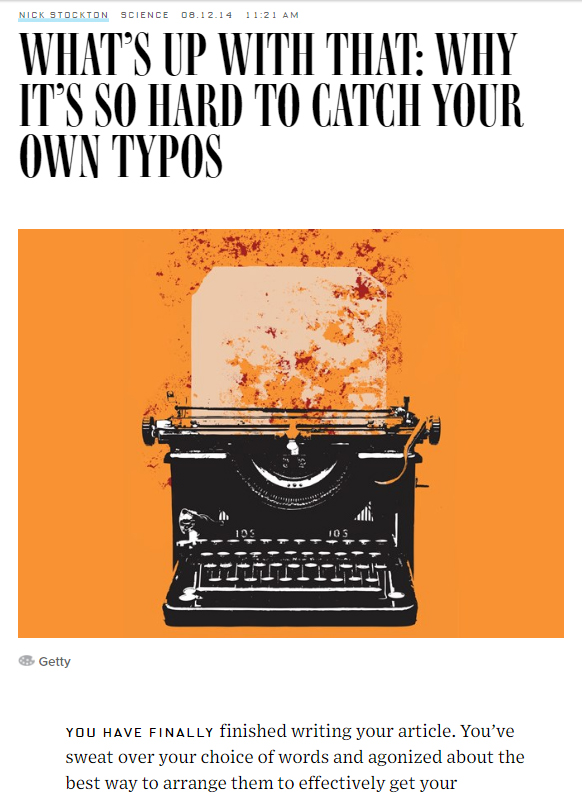
Recently, I’ve been editing Remember. I don’t really like the editing process, but it’s a basic requirement of writing anything. It’s the antithesis of the writing. Editing is a nearly brainless activity in comparison. Editing something over and over still missing some errors is frustrating and motivation crushing. Typo blindness is troublesome. The writer knows the words they intended for the page. Not seeing a few typos each page isn’t really a hindrance for the person that wrote it. This WIRED article does a really good job explaining it. A novel is much more susceptible to typo blindness than say a 10-page research paper. A novel requires a lot of investment. Investment leads to seeing what you want to see, instead of what’s actually on the page.

 wired typos

That’s exactly what happened with Remember. A beta-reader pointed out several typos throughout the book. Unfortunately, I’d already put the ebook and paperback on Amazon. Exactly how that worked out is in an upcoming blog post. I quickly took off those listing. It wasn’t until a few months ago, but I reposted the unedited versions. I’m working on the edits as you’re reading this.

amazon listing 1

After the discovery of numerous typos, I worked out an editing plan. I’d already edited through four drafts at that point. I read slowly through each page twice. Once through a page and then again. Finding typos was easy. The work was time-consuming. I hadn’t yet found a method to stay motivated through more than an hour or so. Two or four pages a day. In a month of doing this, I lost all the motivation I could muster.


The blog has already featured the fruits of my procrastination. I feel too much guilt procrastinating on something completely useless. I have to justify it somehow. That’s how procrastination always starts, as a tangent that can somehow be connected back to the goal. I thought learning Photoshop would help me create book covers that I needed. Then After Effects to make a book trailer. Then 3D modeling for the book trailer. Then game development to practice 3D modeling. This happened in phases between more flawed editing.

wasting time

Through all this, my unconscious was entering the second epoch of my writing style. For some reason I can’t remember, I start thinking along the lines of clarity (an old blog post talked about a writer that showed me the way, Ella Dawson.) I recently read, the biggest mistake of a novice writer is trying to overcompensate for a perceived lack. Usually in the form of over-involved writing. That’s the symptom of Remember. Over complicated prose for confusing and difficult to understand writing. I reasoned if no one can understand what I’m writing, what’s the point. If it isn’t clear, there is no point.


I needed to simplify Remember. I decided to linearize it. Remember started out as two parallel story lines. One was six months ahead of the other. I jumped back and forth. The reader was getting lost. I cut out the boring stuff. Conor court trial and hospital stay were gutted (I’ll post them sometime). I moved the hook later in the novel. I needed a new hook, Conor’s life before the memory loss. What was Conor trying to remember? That should be up on here when I’m putting up the new version of Remember on Amazon.


I wanted the story to be more approachable and familiar. I started switching verb tenses to the past. Earlier in the editing process, I’d already switched out all the verbs for active ones. Tense switching would be much easier. I tried Find and Replace in Word. It was too finicky and took about as much time as the manual way. This verb switching actually helped in the long run. It sufficiently motivated me to cut more of Remember. Cutting from a novel has always been very difficult for me. This extra work of verb switching got me there.


remember cuts
Everything I cut from Remember.


Remember is almost finished. I’ve cut 14,000 words plus, and the novel is better because of it. Listening to music is the motivation I need for editing and typing at times.


Later, guys.


GK

subscribe button

Photoshop: My Best is Yet to Come


This is a gallery of everything I’ve done so far. This is basically my way of procrastinating and not doing the work of writing. This series on Photoshop is wandering a little too far from the goal of this blog.  Most of these are from an up-coming anthology of my best writing in Remember. So here’s the gallery. Enjoy and click through to my Deviant Art page for full resolution.

This slideshow requires JavaScript.


GK

This slideshow requires JavaScript.

subscribe button

Walking Through the Forest of Night to a House so Bright


A story of transformation, finding something unreal, and seeing things in a new way.


Walking through the black forest shakes trepidation through this vessel. I just walk from some unknown location to the warm comfort of my home, each step concluding in pain, as branches thick and dense scratch up every square inch of open flesh. The continual movement through this underbrush offers a constant reminder of what hides just out of sight in the utter darkness all around. The unavoidable trip over an up-turned root or impact with a hearty low hanging branch adds punishment to my circuitous, wandering journey. I need some way to escape this blind torment — a slight reprieve from this suffering — just something, anything to change this sightless wandering.


A deep thumping moves through the forest floor and into my very bones. The need to brace myself to the strength of a behemoth tree possesses my deliberate action. My touch turns into a hug that becomes a death grip with another mighty, ground shaking vibration. A light reflecting back onto the trees — showing their full depth and complexity — grows with the intensity of a dozen suns in the utter darkness of this endless night. A menacing, throaty, animalistic roar from the omnidirectional distant wood sends a shiver down my spine, raising hair as if preceding electromagnetic discharge. An unwitting glance in the general direction blinds and reveals. I will and force my body to unleash the hold upon this mighty protector, this sentinel of a tree. I reluctantly gaze at the source of bright emanations floating ahead of this feeble body. The illumination acts as a giant obfuscation of my true savior, whatever form of creature may yet it be? I approach with a heart halting terror and unbridled curiosity, unhindered by neither. This encroachment continues until the ultimate conclusion of facing this thing.


The light fades to a faint glimmer of the once magnificent beacon, facing me with the stuff of nightmares — a monstrous feline form waiting to tear meat from bone. The shiny salivating mouth, at the ready, takes no action except to show itself. I feel this undeniable need to touch the top of its slick, black hair covered head, so much so that I just do it. Combing my fingers through the thick, luxurious fur that encompasses this unearthly beast coaxes purrs of the cat’s pleasure. The agape mouth recedes to that of a happy kitten with no interest in ingesting my delicate flesh. Another one of pure white enters the clearing, looking for some unknown treasure. The newcomer requests the same tender moment, displaying its gentle face near that of the other. I indulge the arrival with the same strokes to receive the much needed safety and security. With each stroke, the wild and feral nature of these beasts transforms into the kinder, gentler forms of pet cats with diminutive size.


The two cats pull back as if something calls their attention away from this. They move past me deeper into the overly dense growth. I follow as they are now my acolytes in the unfamiliar terrain, giving myself over to their animalistic instinct with no other recourse than belief in their prerogative. I trust them implicitly as sheep lend themselves to the whim of the herder. They move from branch to branch with a graceful ease, occasionally leaping to ground without faltering. The white lioness, the feline is bombarded with distraction meant to disrupt — wandering thoughts of something unknown. She flees at some indiscernible input abandoning him and me. I follow the member of our party devoted to our mutual interest, getting me out of these accursed woods. We approach a house of black smoking chimney and yellow glow through window. He makes himself comfortable here, a sign for me to enter the hidden, secret chambers within. He swiftly climbs an overhanging tree, drops down upon the lowest eaves, and curls up onto a ball. A peaceful slumber is the lofty goal of this lowly, once majestic creature.


Entering the bleak, sterile innards of this home leaves something to be desired besides modernity. The organic, although dark forms outside provide more of a comfort than this… barren cold. I go through the myriad of metallic cabinets and bins, looking at everything and searching for nothing. The white floor offers the only change from this… storage on every side. I pantomime my way around the room, searching the cold walls for the misplaced door, failing at a hidden compartment or any other such thing. The cold leaches into my hands, trying to rip my very essence away. I stop in futility. A noise startles me into looking one way. The cold at my back melts away to nothingness. A look back offers nothing, except black air surrounding this body. The limited surroundings are no more. Trying to escape the whiteness below, running into the dark proves this space inescapable.


Somethings come out of the black void and surround me in tight ring after ring. The objects flicker into life showing him to me, the black feline lounging above in various states — anything from growling to purring, eating to sleeping, back arching to scratching, and hunting for some elusive prey. The images send me through waves of reflected emotion. The scratching comes to gradual focus. The images look too real for my own good, the scratches too close. The hot searing pain cries out from every part of my outsides. The resulting outflow of blood provides a limited relief. I just want and need this perpetual torment to cease! This unavoidable pain must come to an end. I just have to get out! I welcome the sweet slumber of sleep that is death alone.


GK

subscribe button

How to Learn Photoshop for Bookcovers


Photoshop is the professional standard for book covers. The question used to be if Photoshop CC was worth the nearly absurd cost. For the first time desktop software leasing made sense. 6,000 bucks is unbelievably expense. Adobe’s Photoshop CC is now 19 dollars a single month or 10 dollars every month for a year.

Photoshop_icon.svg

The big question is do you really need Photoshop CC or will the consumer version, Photoshop Elements, be good enough? Photoshop Elements is missing a few things that I think separate something that looks professional and something that looks shabby. What features am I talking about? Blend modes and the opacity slider. The blend modes allow more control in the way image layer over each other. If composting two images is required, blend modes are huge. The opacity slider controls how strongly one image imposes on everything below. Another big one the text kerning or fine tuning the spacing and position of each letter. Almost every single book cover I’ve ever seen use kerning, stretching letter, composting, and blending tweaks.


stock images

Making a book cover requires a few things. Access to Photoshop, a book cover idea, a repertoire of Photoshop effects, and a collection of stock photos that can be used for a cover. The last one is the toughest if graphic design isn’t your day job. Look at this list over on Medium for free stock image sources. Check the usage rights always. Watch a ton of Youtube videos to build a repertoire of Photoshop effects. Look at an earlier blog post for book cover ideas. Now we have everything we need.


https://www.youtube.com/watch?v=-rNSjTAFvjU&t=1299s&ab_channel=IlyassMami

Photoshop isn’t a daunting thing to learn. The entire process is basically the tweaking and playing around with sliders governing everything in there. You can be artistic or not. It all comes down to comparing an image before and after every change that’s made. What looks better to your eye and such.


I’ll show something that I stumbled into while trying to do something else. I had this image. I wanted to add another image around the color gradations (one color changes to another). I tried making a highly detailed mask by copying the picture and getting the difference from the original slightly shifted. That got me something strange. It looked like an interference pattern.


I tried removing the color from both. Didn’t work. Then I started playing around. Trying every possible combination of color and no color, each blend mode, opacity level. Something along the way looked interesting. That’s how this happened. More details here.


In two weeks, I’ll post a gallery of everything I’ve done so far, photo-manipulations and book covers. Another fiction post coming up soon.


Later guys.


GK

subscribe button

What Should My Novel’s Cover Look Like?


Book covers are the first thing any potential reader sees. A book shouldn’t be judged by it’s cover, but first impressions are really important. I’m writing this to explore my ideas about how to decide what should be on a book cover.


I learned a lot by watching these videos from Chip Kidd. He talked about a few theories of graphic design. Don’t put a word in text and show a picture of the same thing.

Mystery or clarity. The cover should gently nudge a reader in one direction or clearly show what the book is about. Carefully decide on a balance.

The final video is a collection of book titles, book descriptions, and cover iterations.

Also, keep in mind, the cover should fit the conventions of the genre. The advice I’ve heard is go to a library, find a lot of books in your genre, and identify trends. I’ll give the covers of books I’ve read and what I think are the conventions for each.

Science Fiction: Frequently shows something that’s different in the world that’s created inside. Basically, the story element that’s makes it Science Fiction. Sans-serif font.

Fantasy: The person or object that makes the book fantasy. Frequently a person. Sans and Serif fonts.

Thriller: Person or text. Big font. High contrast. Simple lettering usually.

Young Adult: Sans. One main graphic or image. Background that isn’t too distracting. Clear images.

Romance: Two people together or something symbolizing love. Slightly interesting font.

Literary: Interesting text. Simple background. Setting, object, or overall idea.

Fiction: Person, place, or thing of focus in the story.

Mystery: Something that relates to the scene of the crime, victim, or perpetrator.

Non-fiction: Person, place, or idea the book is about.


I hope this helps. Graham Kar out.


GK

subscribe button